

Kinspot™ — SOS Watch That Calls Your Family, No Subscription
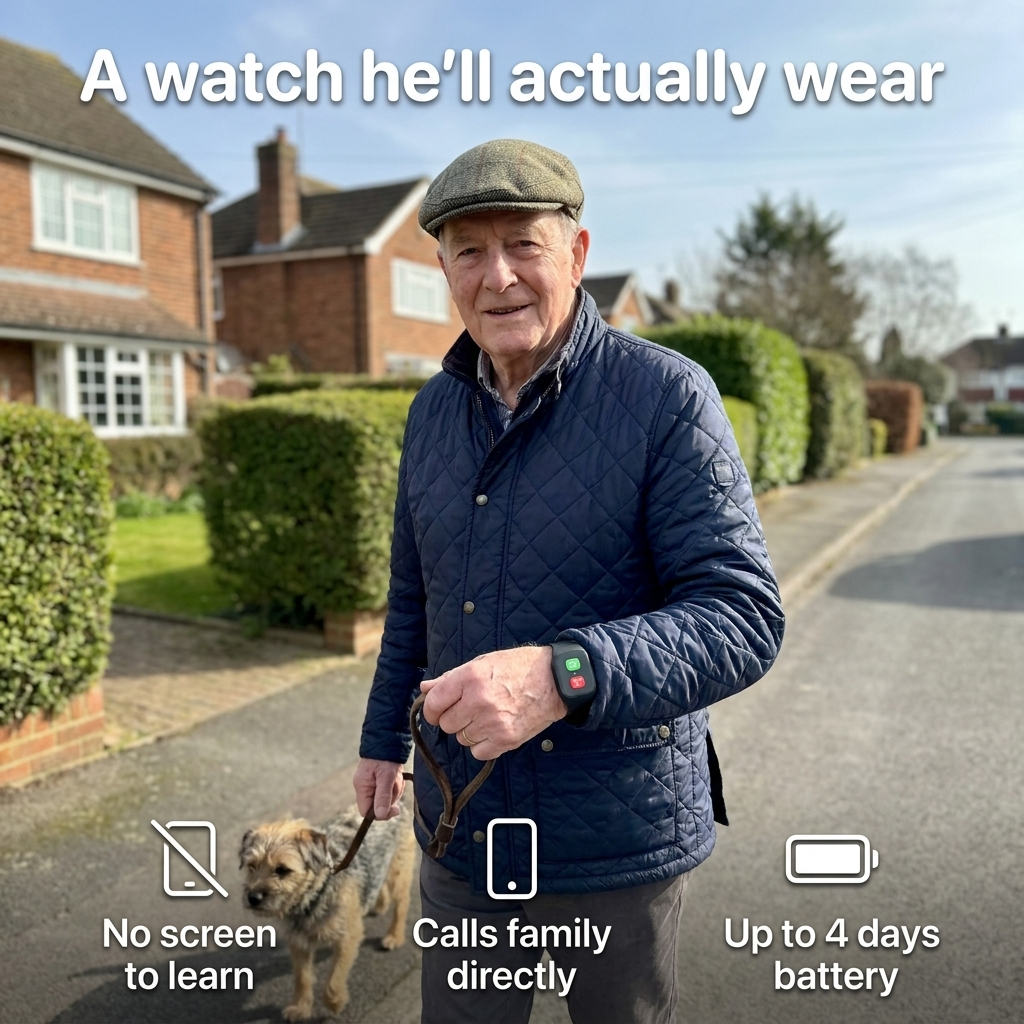
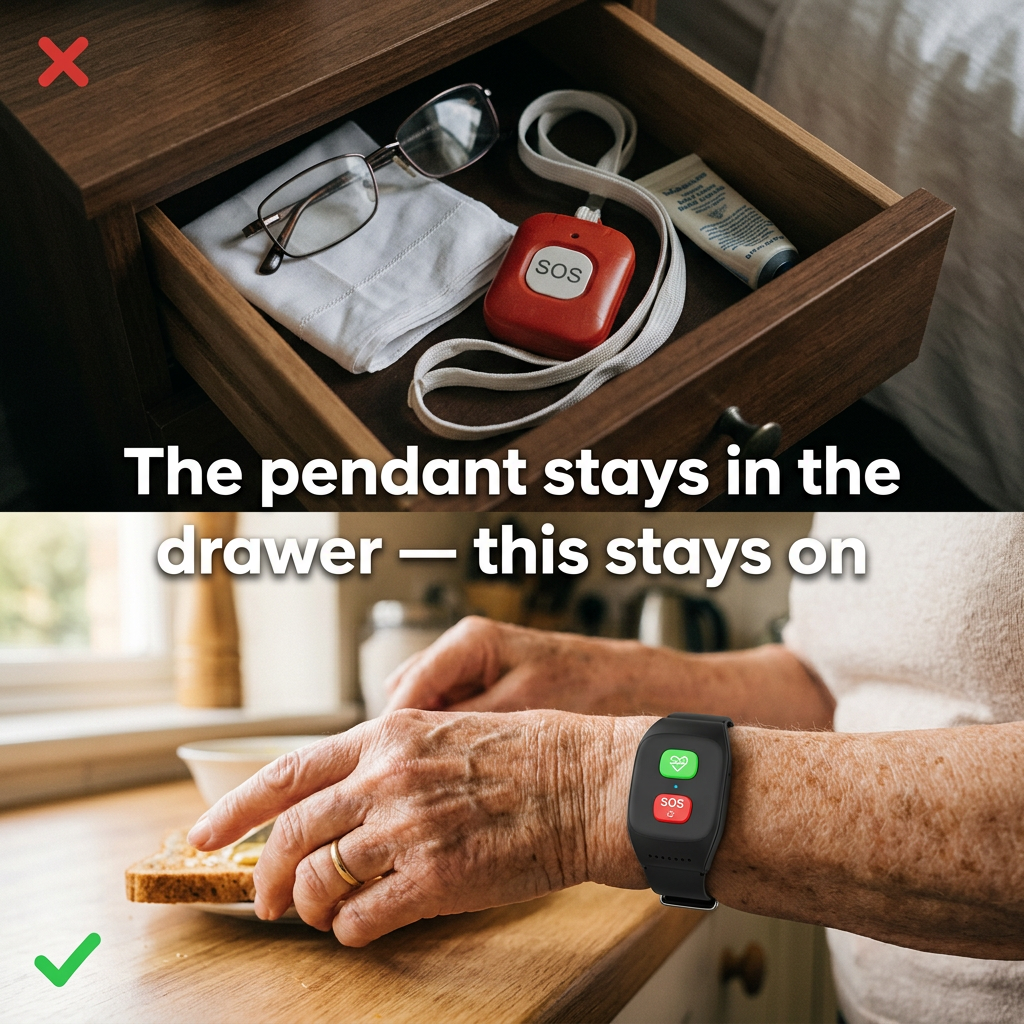
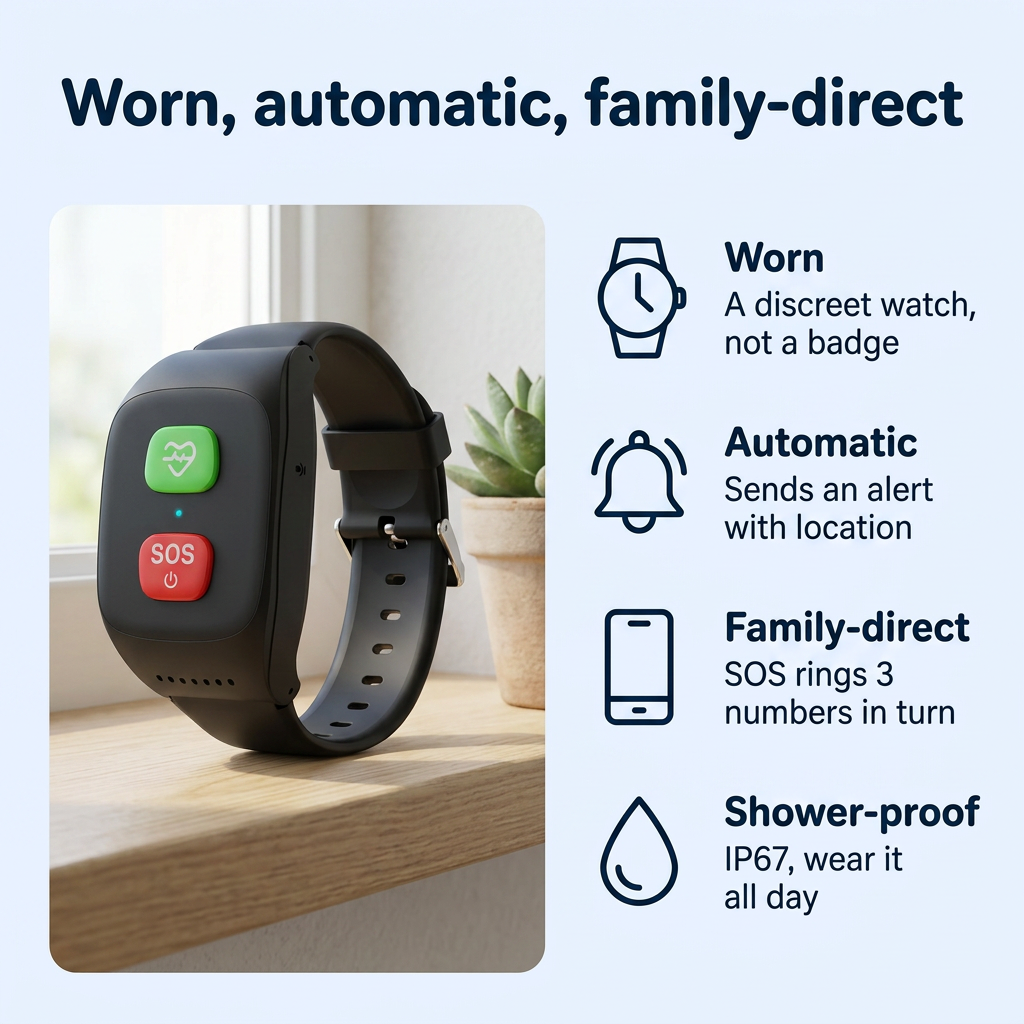
⌚ Worn-first design — a discreet watch with no screen to learn, not a red pendant that ends up in a drawer
📞 SOS calls your family — 3 numbers in cascade, two-way voice call, plus fall detection with location shared
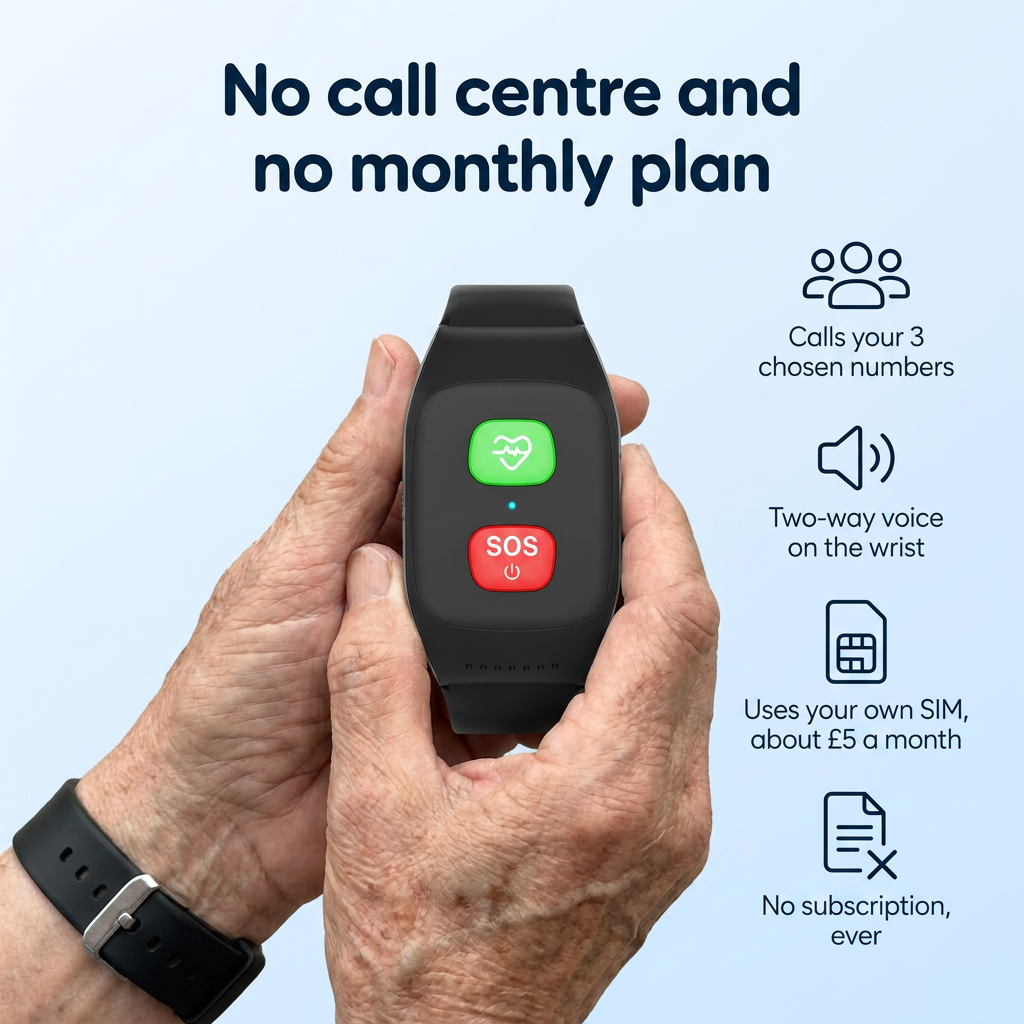
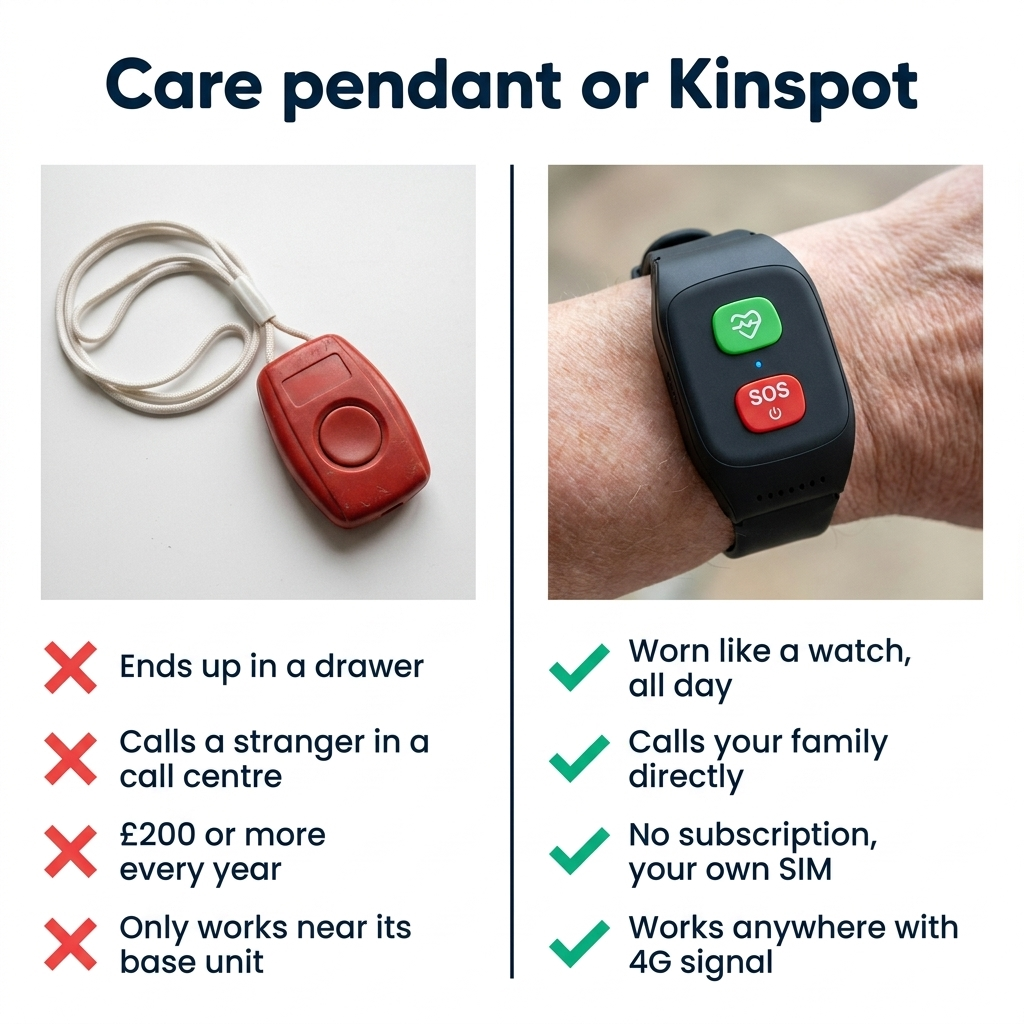
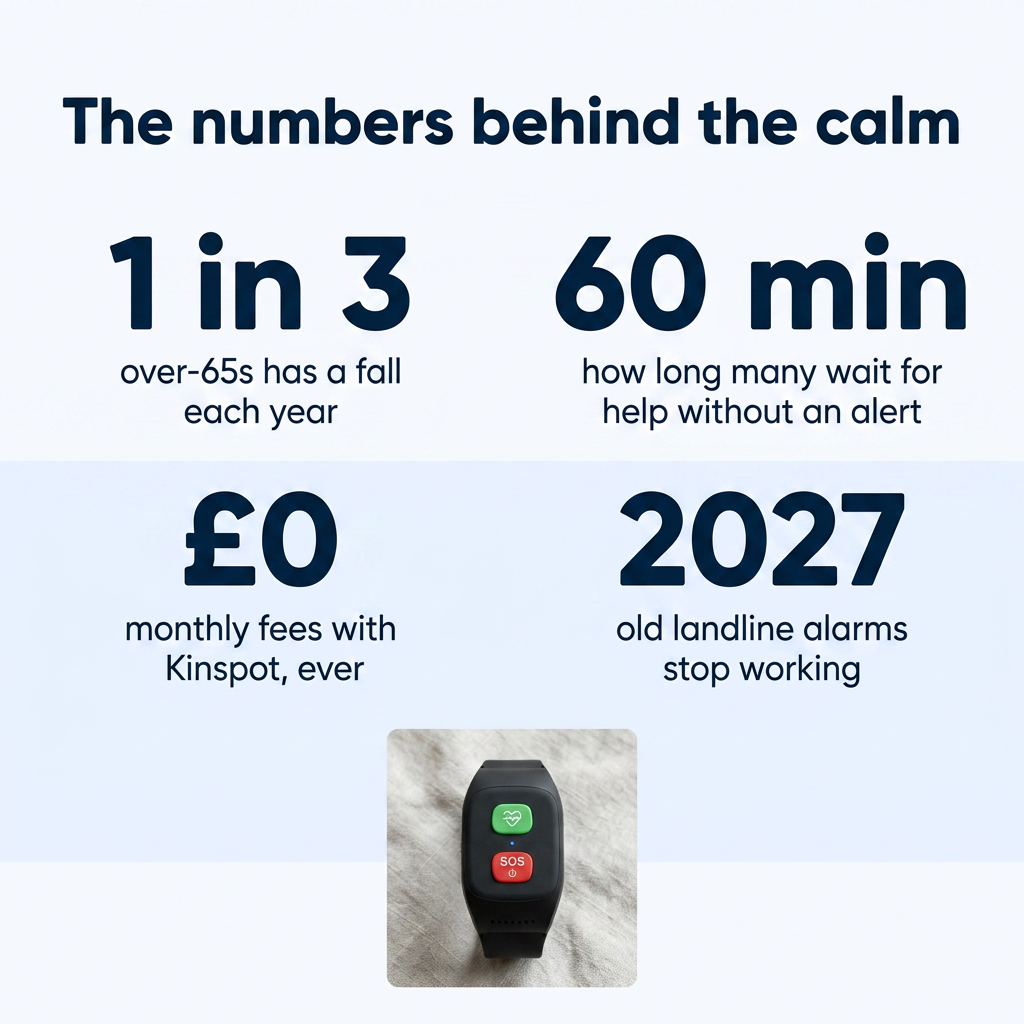
💷 No subscription, ever — any UK SIM (~£5/month, not included). About £145 year one vs ~£500 monitored plans
Kinspot™ — SOS Watch That Calls Your Family, No Subscription
The pendant alarm has three ways of failing. All of them are human.
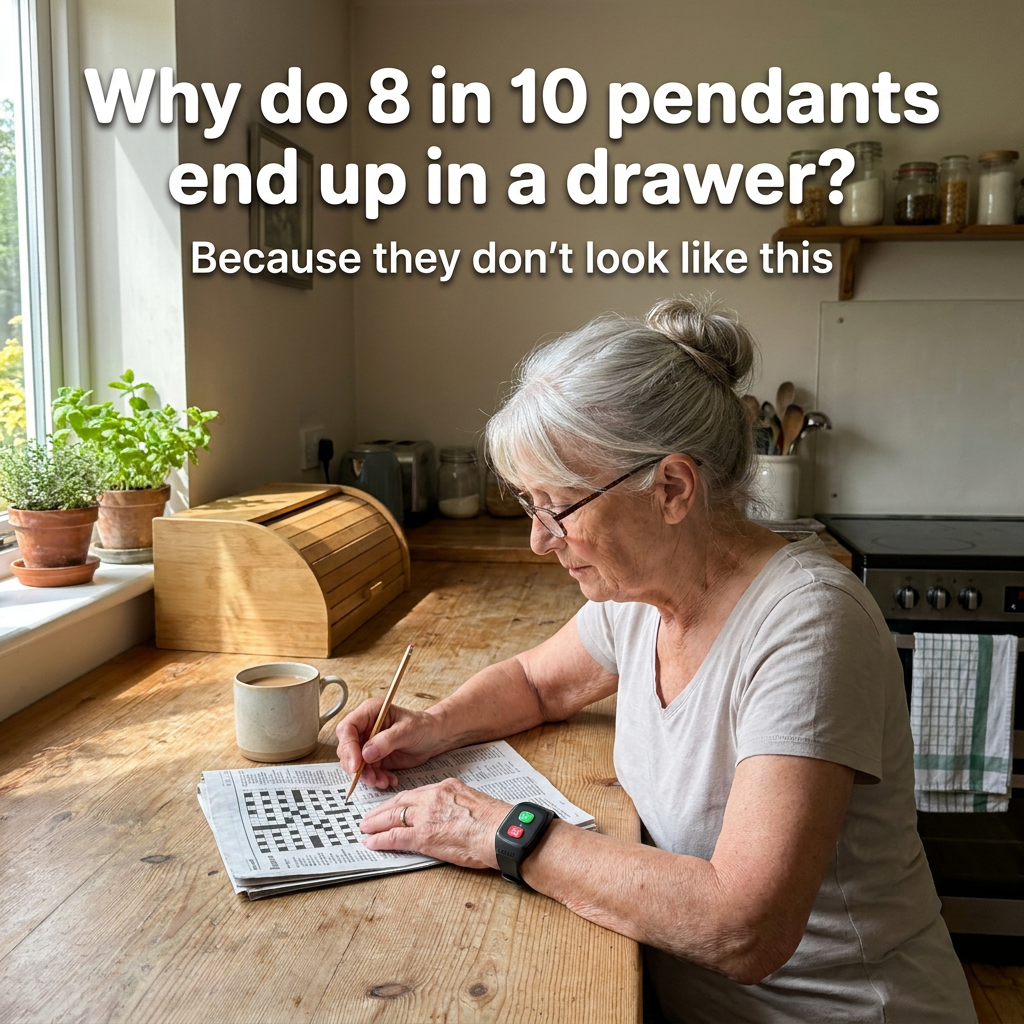
Somewhere between 70 and 80% of pendant alarms are not being worn at the moment of the fall. The technology works. The plan around it doesn't.
1. It's in the drawer
"She knows where it is." On the bedside table, next to the reading glasses. A red button on a lanyard says old and frail every time she catches it in the mirror — so it comes off. An alarm that isn't worn protects nobody.
2. It's worn — but never pressed
Carers say it again and again: after a fall, in the shock and the embarrassment, people simply don't think to press. Or they don't want to "make a fuss". One family counted seven A&E visits in three months — the alarm never sounded once.
3. Then comes the long lie
One faller in five who can't get up spends more than an hour on the floor. Of older people admitted to hospital after a long lie, half die within six months. The damage isn't the fall — it's the hours nobody knew about.
"She was on the kitchen floor for hours, beating her walking stick on the ground, until the lovely neighbour who had a key eventually heard her."
— A daughter, Mumsnet "Elderly parents" board. The pendant was in the house. It wasn't on her wrist.
The battle isn't detection. The battle is whether it's on her wrist at half past three on a Tuesday.

The milkman used to notice. Now nobody does.
There was a time when an older person living alone was watched over without anyone calling it “care”. Two milk bottles untouched on the step and the milkman knocked next door. The neighbour had a key. The family lived three streets away, not three counties.
That net is gone. 4.5 million people over 65 now live alone in the UK — a million more than a decade ago. Around 30% of over-65s fall each year, half of over-80s. The children who would have noticed live hours away, and the milkman stopped coming in the eighties.
The industry's answer was a red pendant and a monthly invoice. Ours is different: put the signal back where it always belonged — with the people who love her. Kinspot is the milkman at her wrist: a quiet, ordinary presence that only speaks up when something is wrong, and speaks directly to you.
You can't move back three streets away. You can be the one her wrist calls first.
Worn-First Safety — three layers, in the only order that works
Every layer below only matters because of the one before it. Most alarms are built the other way round.
⌚1. Worn
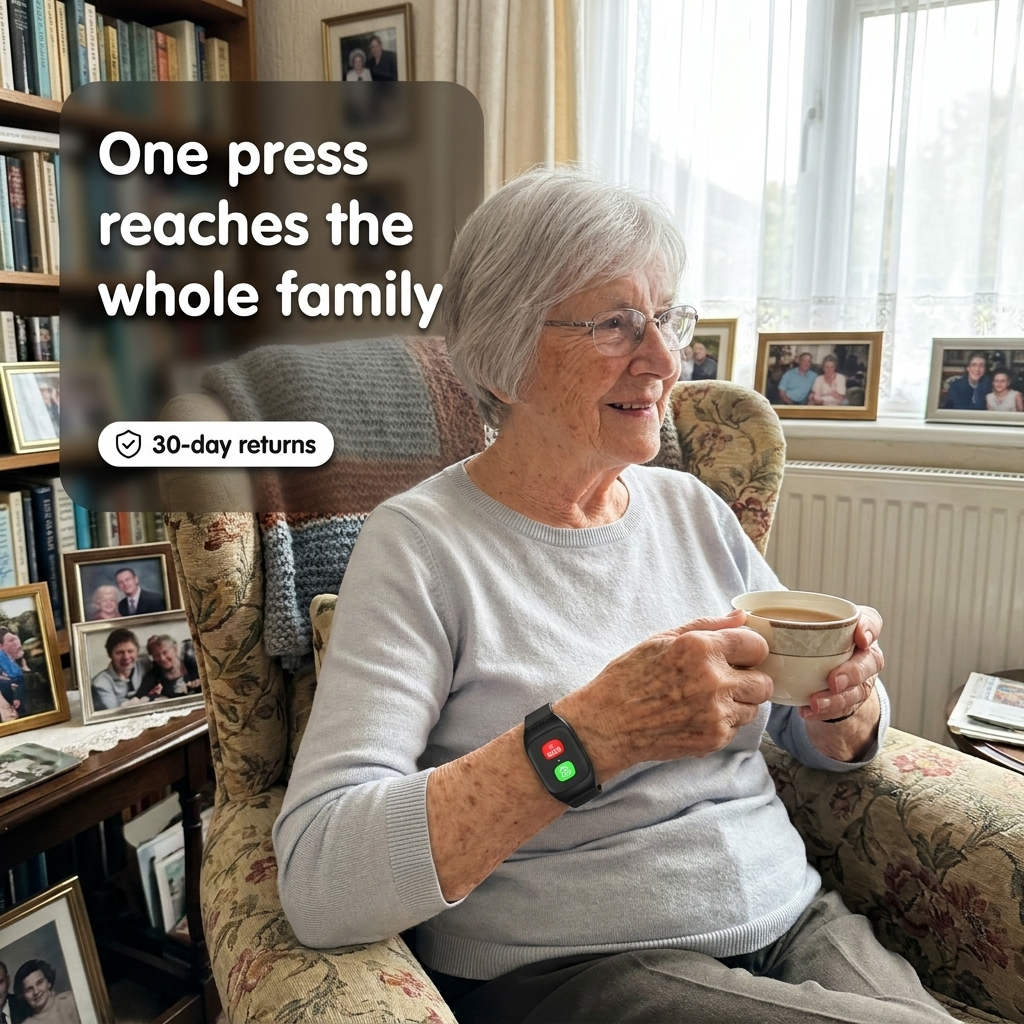
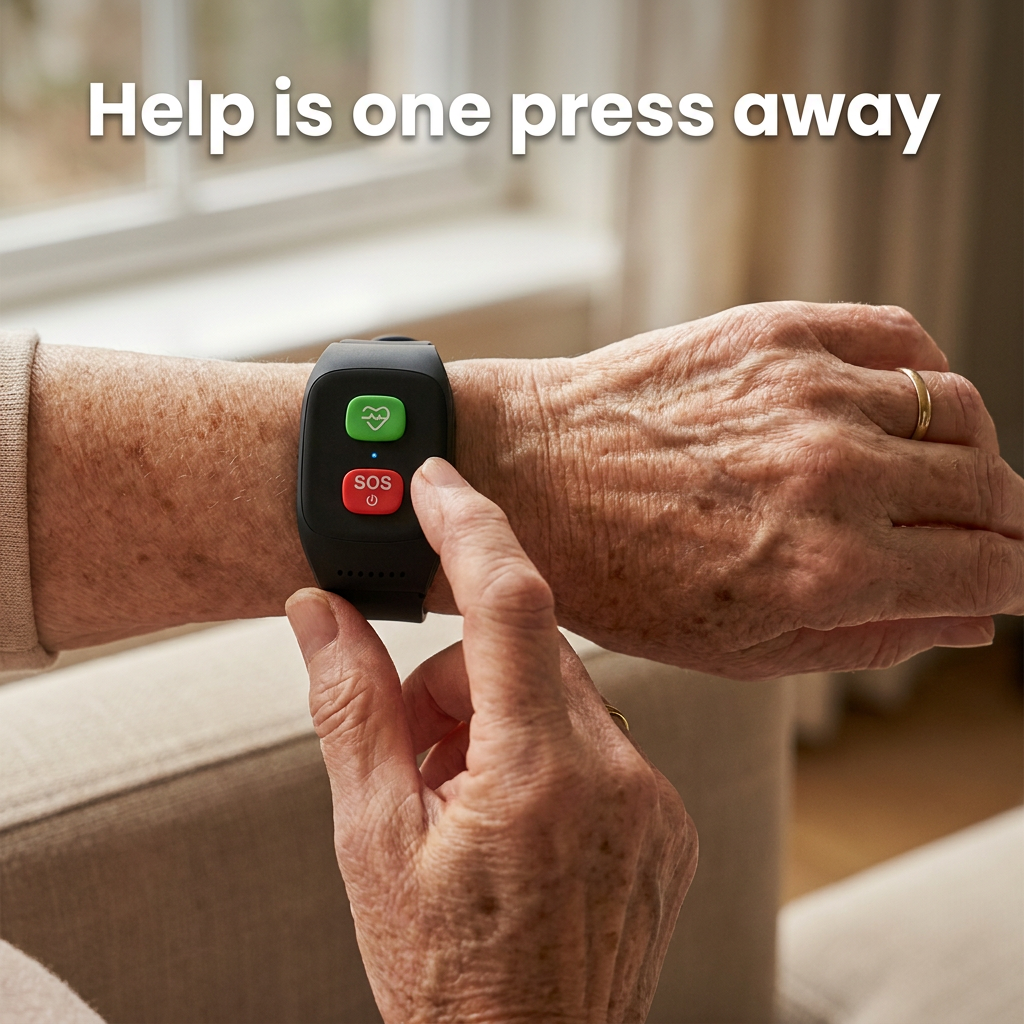
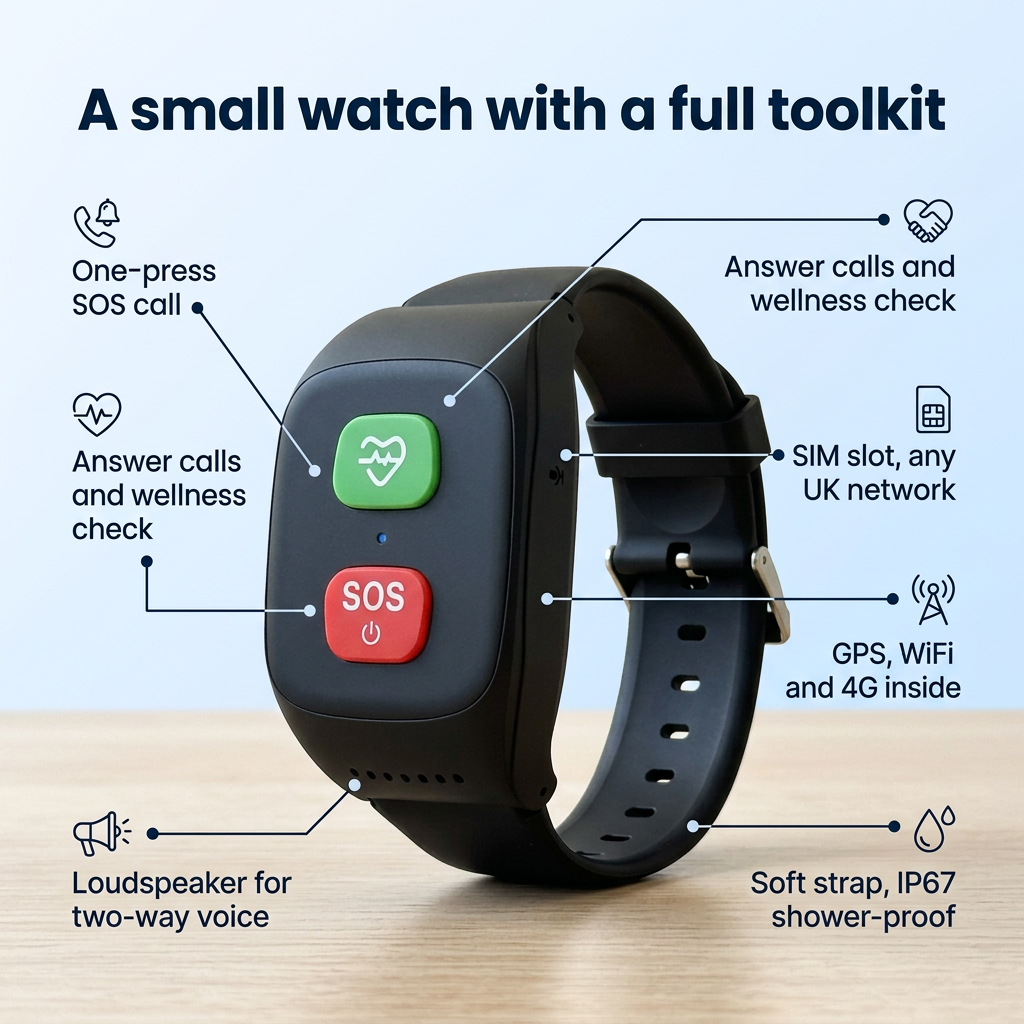
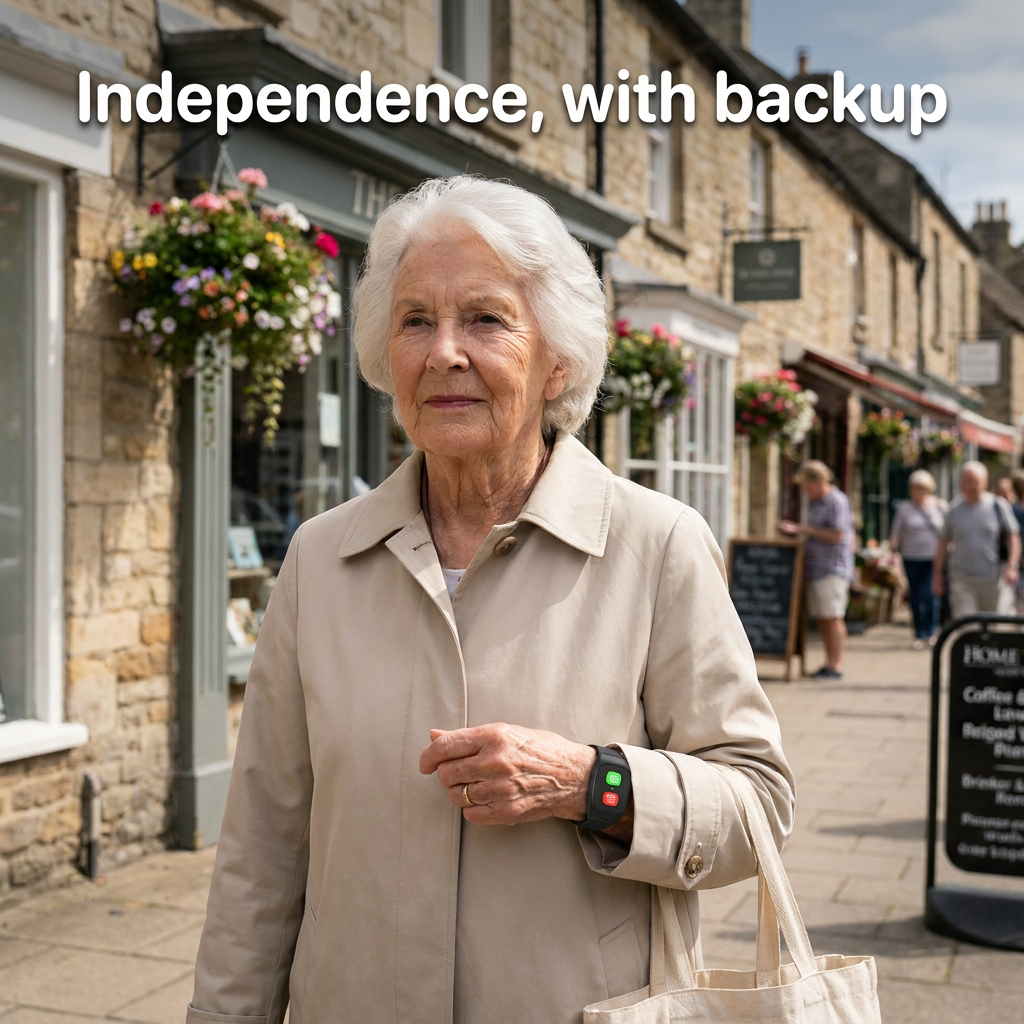
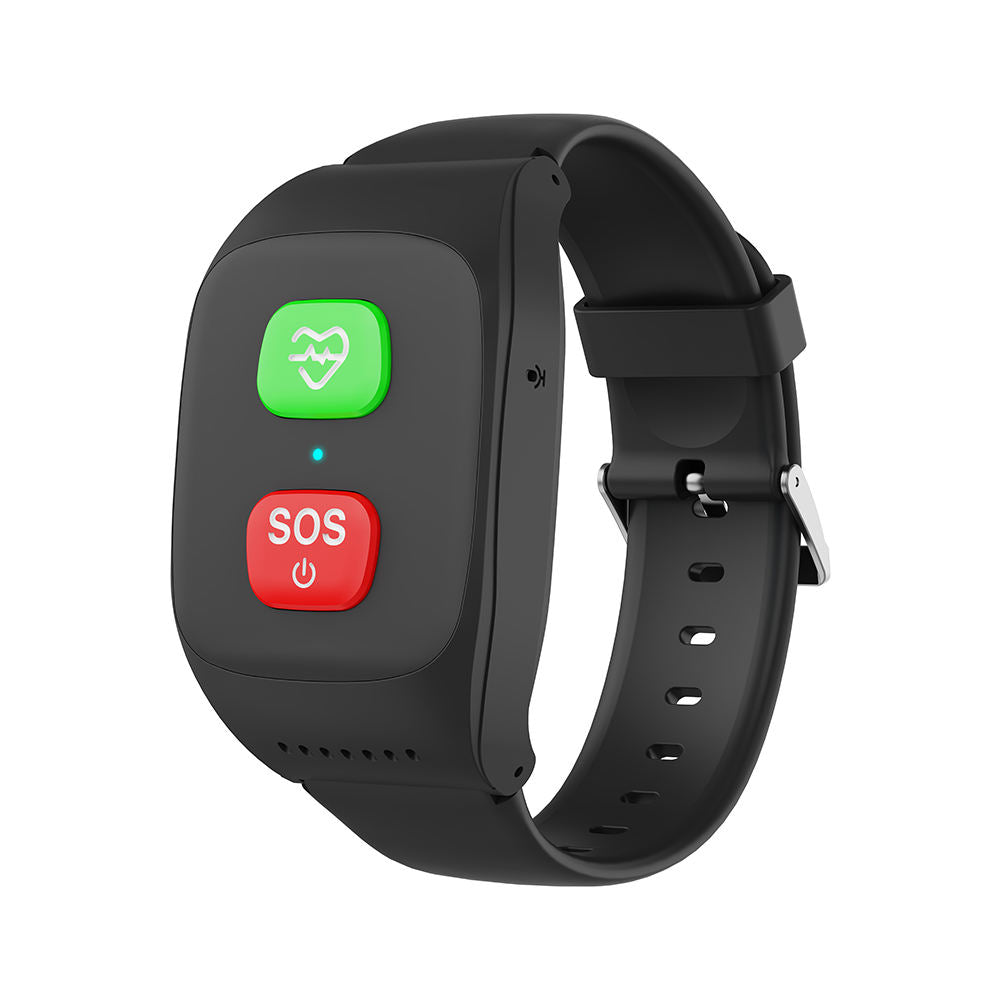
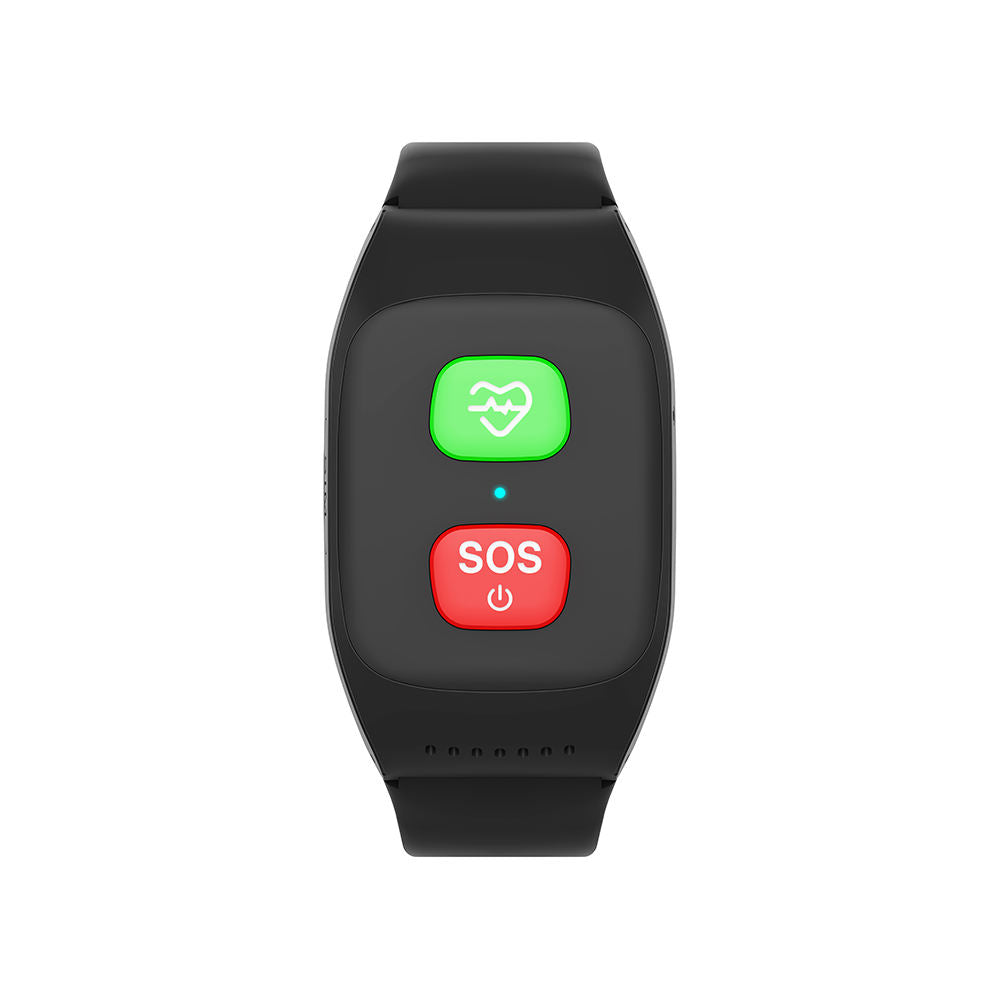
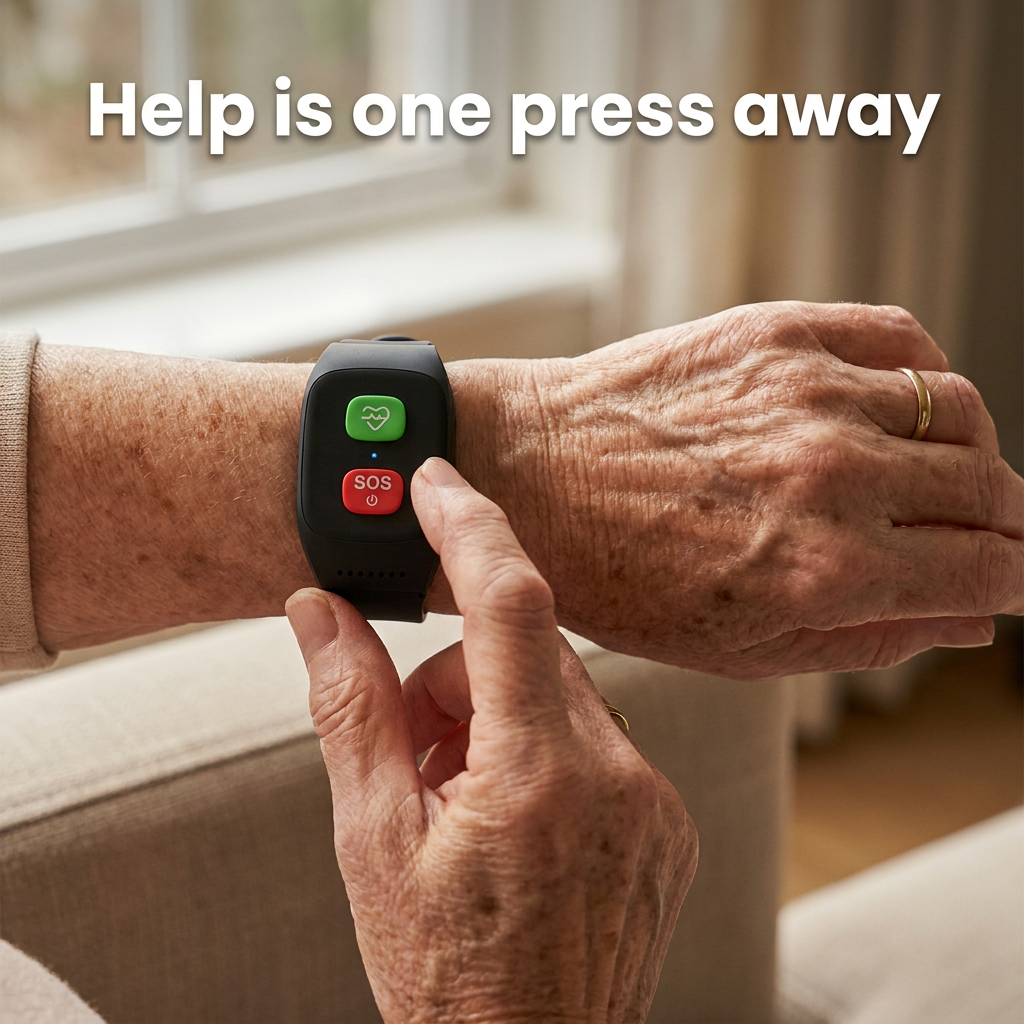
It looks like a watch, because it is one. Discreet, no screen to learn, two physical buttons. Nothing about it says "telecare".
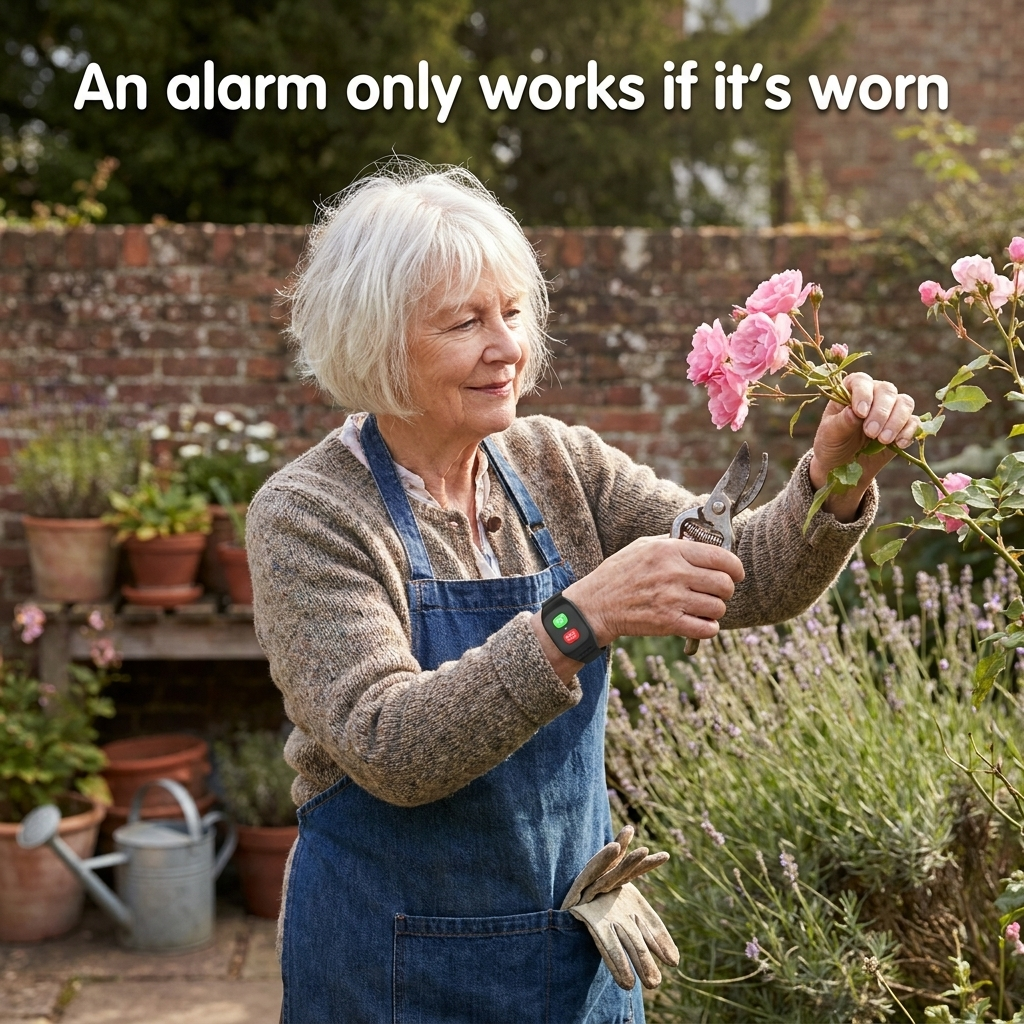
She wears it for the same reason she's worn a watch for sixty years — which means it's actually there when it's needed.
🛟2. Automatic
Fall detection + location sharing. If a hard fall is detected, Kinspot can raise the alarm and share where she is — the net for the moments when nobody presses anything.
Honestly: no fall detection catches every fall. That's exactly why the SOS button is always one press away.
📞3. Family-direct
SOS calls your family, not a call centre. One press rings up to three numbers in turn — a real two-way voice call, at her wrist. If the first doesn't answer, it moves to the next.
When she's on the floor, she doesn't want a stranger with a script. She wants to hear her daughter's voice.
⌚ She'll wear it for one reason: it doesn't say “old”
King's College London researchers found the strongest predictor of refusing an alarm isn't frailty — it's how healthy a person believes themselves to be. The refusal is identity, not stubbornness. A red button on a lanyard asks her to agree, every morning, that she is now someone who needs one.
A watch asks nothing. She's worn one for sixty years.
⌚ No screen, no menus — nothing to learn, nothing to mis-tap. The time, and two buttons
🔴 SOS button — one firm press rings the family cascade
💊 A gentle vibration for medication reminders — set by you in the app, felt by her at the right time
🚿 Stays on — IP67 means the washing up and the shower are fine, so it never needs to come off and get forgotten
On Mumsnet the breakthrough is always the same sentence: “she finally agreed — provided it was a watch-style one.”
What year one actually costs
Monitored alarm services charge every month, for life. Kinspot is bought once — the only running cost is the SIM you choose and control.
Less than two months of a monitored plan — then it's yours. Year two: just the SIM. Competitor prices from their published tariffs, July 2026.
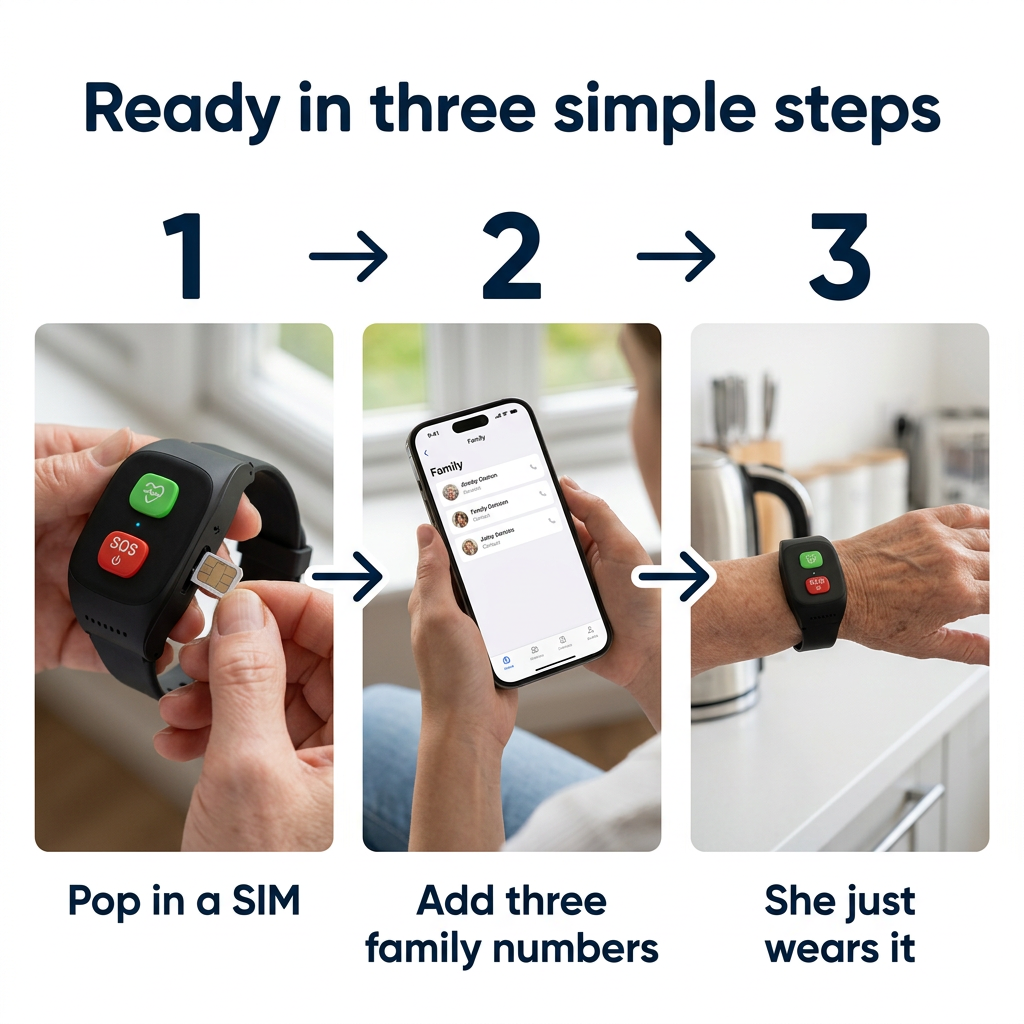
Set it up before you give it — she just puts it on
Everything technical happens at your house, not hers. By the time Kinspot reaches her wrist, it's just a watch that works.
Fit the SIM
Any UK nano SIM with voice and data (~£5/month). Turn its PIN lock off first. The Ready bundle includes a step-by-step guide to the best-value UK options.
Pair the app
Download the free app on your phone, scan the QR code on the watch. No account fees, no advertising.
Add your three numbers
You, your brother, the neighbour with the key — the SOS cascade rings them in the order you choose. Add medication reminders if she'd find them useful.
Give it as a gift
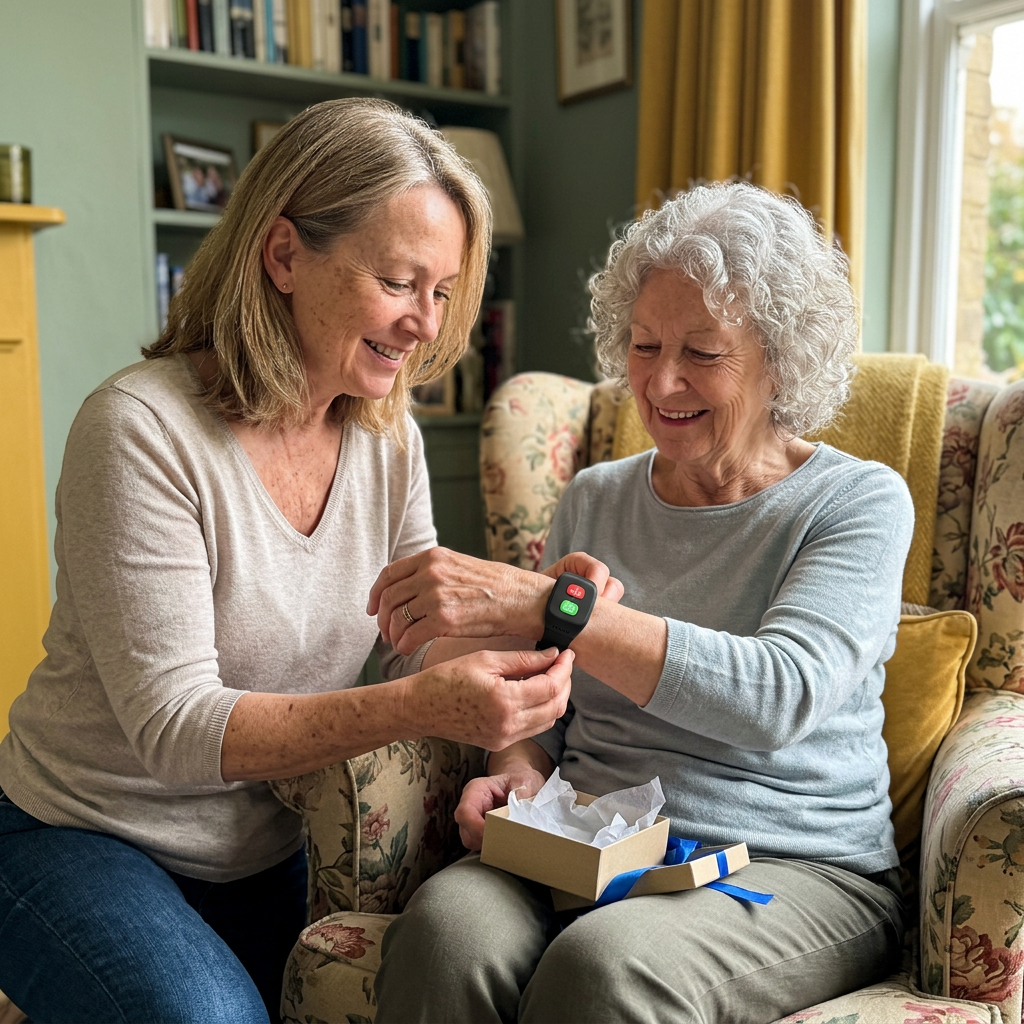
A watch in a box, not an instruction. Set the time, show her the two buttons, and let her wear it out of choice. That's the step that makes all the others work.
About 20 minutes from box to wrist — and the Ready bundle's bedside card means she never has to remember any of it.
If she says “I don't need one of those” — read her this
“Mum — this isn't about you being old, and it isn't about me checking up on you. It's a watch. If anything ever happens, it rings me — not an ambulance, not a stranger in a call centre. Me. And the honest truth is, it's as much for my sake as yours: I'd like to stop worrying at seven o'clock every evening. You'd be doing me a favour by wearing it.
And it's what lets you stay here, in your own house, on your own terms — which is what we both want.”
She isn't refusing safety. She's refusing the badge. Offer it as a watch, as a gift, as a favour to you — and let her say yes on her own terms. She is the co-decider here, not the subject of a decision.
What you're really giving her is the right to stay in her own home.
Families who stopped ringing at 7pm
★★★★★ 4.9 — from UK families
Mum wears it. That's the review. The council pendant sat in a drawer for two years; this one looks enough like a watch that she put it on and never mentioned it again.
Helen R., Bristol
Dad pressed the button in March when he slipped in the garden. My phone rang, I could hear him straight away, and I was there in twenty minutes. No call centre, no waiting on hold.
James W., Leeds
We were quoted nearly £500 a year for a monitored alarm. This was £85 once plus a £5 SIM. Same peace of mind, and the alert comes to me, not to a stranger.
Priya S., Manchester
Setup took me half an hour rather than twenty minutes — turn the SIM PIN off first, learn from me. Since then it's been faultless. The medication vibration is the sleeper feature.
David M., Norwich
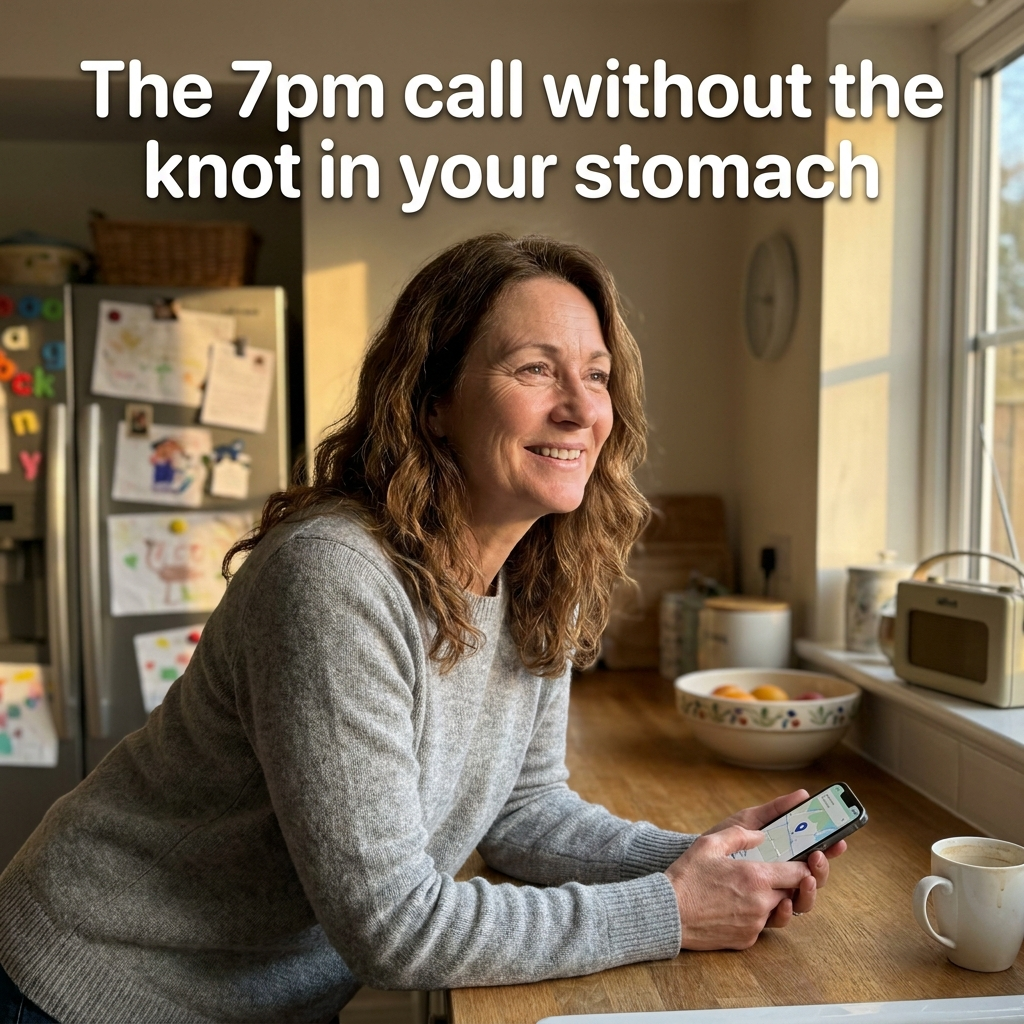
The 7pm call used to run my evenings. Now I glance at the app, see she's been up and about, and ring because I want to chat — not because my stomach is in knots.
Sarah T., Glasgow
My mother-in-law refused three different pendants. We gave her this for her birthday as "a watch that can ring Karen" and she wears it every day. The framing matters — the page is right about that.
Karen B., Cardiff
Her old alarm only worked near the base unit in the hall. This works in the garden, at the shops, on the bus to her sister's. That's where the falls actually happen.
Tom H., Sheffield
Battery is honestly three days with daily calls, not four — plan around it and it's fine. The second charger in the Ready bundle lives at my house for when she visits.
Angela P., Nottingham
Frequently Asked Questions
Does it need a SIM card — and what does that cost?
Yes, and it isn't included. Kinspot is a small 4G phone on a wrist: without a nano SIM with voice and data it can't call and can't share a location. Any UK network works — a PAYG or low-cost plan at roughly £5 a month is plenty. Turn the SIM's PIN lock off before inserting it. The Kinspot Ready bundle includes a step-by-step guide to the best-value UK options.
Is there really no subscription?
None, ever, to us. The family app is free and carries no advertising. You buy the watch once and you own it; the only running cost is the SIM you chose, on a contract you control and can cancel. Over year one that's about £145 all in — against roughly £500 for Taking Care Anywhere or £760 for a CPR Guardian Gold plan.
What exactly happens when she presses the SOS button?
The watch rings the first number on your list. If there's no answer it moves to the second, then the third, until someone picks up. It's a real two-way voice call at her wrist — she talks and listens without touching anything else — and the app shares her location with the family at the same time. If nobody on the list can answer, nobody answers: that's why there are three numbers, and why they should be people who can act.
Does the fall detection catch every fall?
No — and nobody's does, whatever their adverts imply. Hard falls with impact are what it's designed for; a slow slide down a wall or a fall from sitting may not trigger it. That's exactly why the SOS button is the hero of this product and fall detection is the net underneath it. If a company tells you their detection catches everything, they are describing a product that doesn't exist.
My mother refuses to wear anything like this. Why would this be different?
Because it's a watch, and she's worn one all her life. Research from King's College London shows the refusal is about identity, not safety — a red pendant announces frailty; a watch announces nothing. The families who succeed offer it as a gift and as a favour (“it rings me, and I'll worry less”), not as an instruction. There's a passage on this page written to be read aloud for exactly that conversation — and if she still won't wear it, our 30-day returns cover that too.
Are the health readings medically reliable?
No — and we won't pretend otherwise. Heart rate, SpO2, wrist temperature and sleep are wellness indications for general awareness: useful for noticing that Mum's been up and about, not for diagnosing anything. Wrist blood-pressure readings in particular are approximate. Kinspot is not a medical device, and no reading from it should ever replace a GP. What it's for is the pattern — the reassurance of a normal day visible at a glance.
Can I listen in on her through the watch?
No. Every call rings audibly and is answered on the watch, like any telephone. There is no silent remote-listening function, we won't enable one, and we won't add one in an update. Checking that someone is safe and eavesdropping on them are different things, and we are only in the first business. Her location is shared with the family accounts you set up — and with nobody else.
What about battery life and water?
Up to 4 days on a charge in normal use — frequent calls and location checks bring that down, so plan on charging twice a week. The magnetic cable clicks on rather than plugging in, which arthritic fingers appreciate, and the Ready bundle includes a second charger. Water: IP67 means rain, washing up and showers are fine. Baths and swimming are not — take it off.
How accurate is the location — and does it work away from the house?
Kinspot uses GPS, Wi-Fi and mast signal together, and it works anywhere her SIM has 4G coverage — the garden, the shops, the bus to her sister's. Outdoors with clear sky, expect street-level accuracy. Deep indoors it leans on Wi-Fi, which is less precise; in remote countryside it's GPS alone. Nobody can promise a permanent, exact position — but unlike a pendant tied to a base unit in the hall, it isn't limited to 600 metres from home.
What if it doesn't work out?
30 days to send it back for a full refund, for any reason — including “Mum won't wear it”. Beyond that it's covered by a 12-month warranty. Support@novell-home.com reaches a person, and there's a contact form beside these questions.