
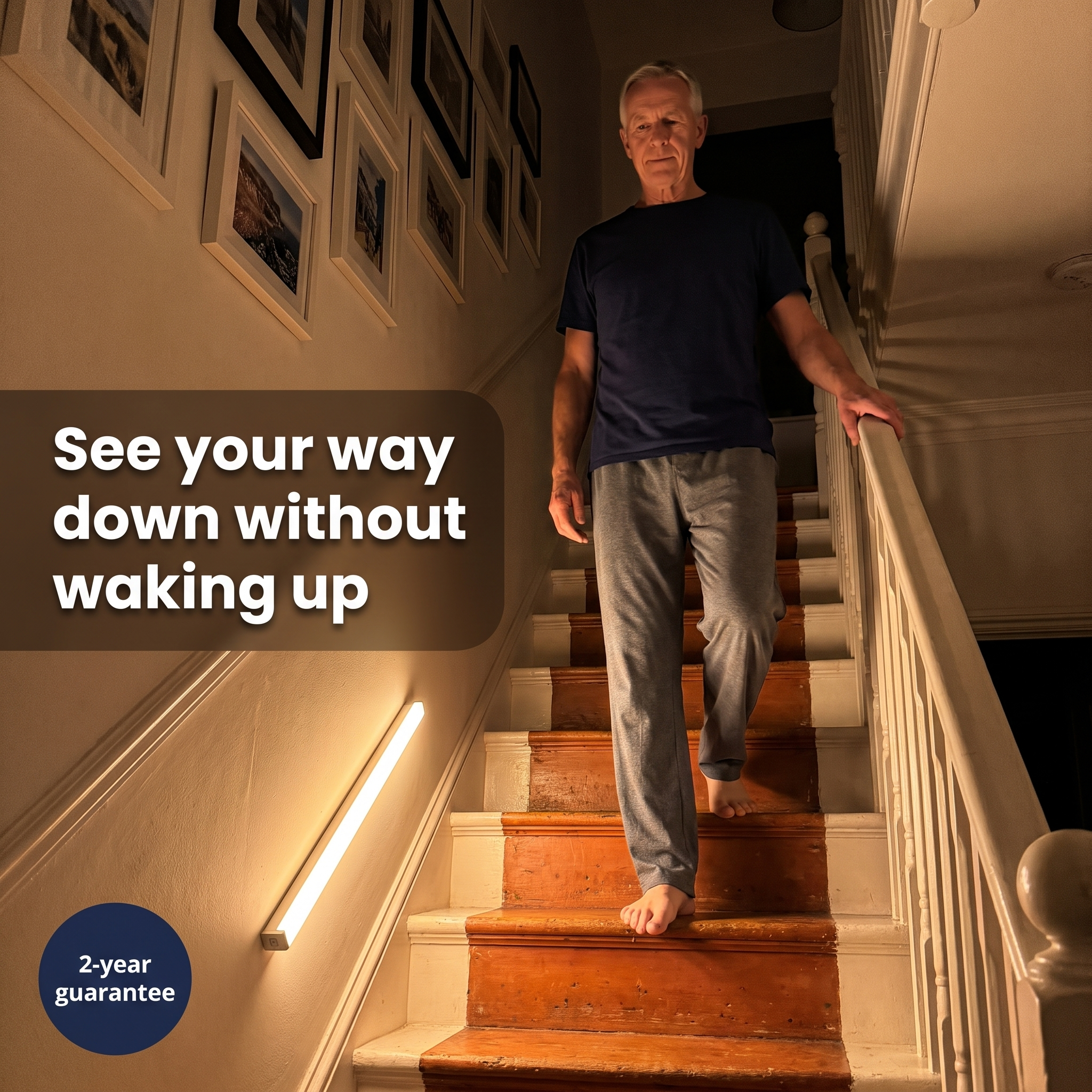
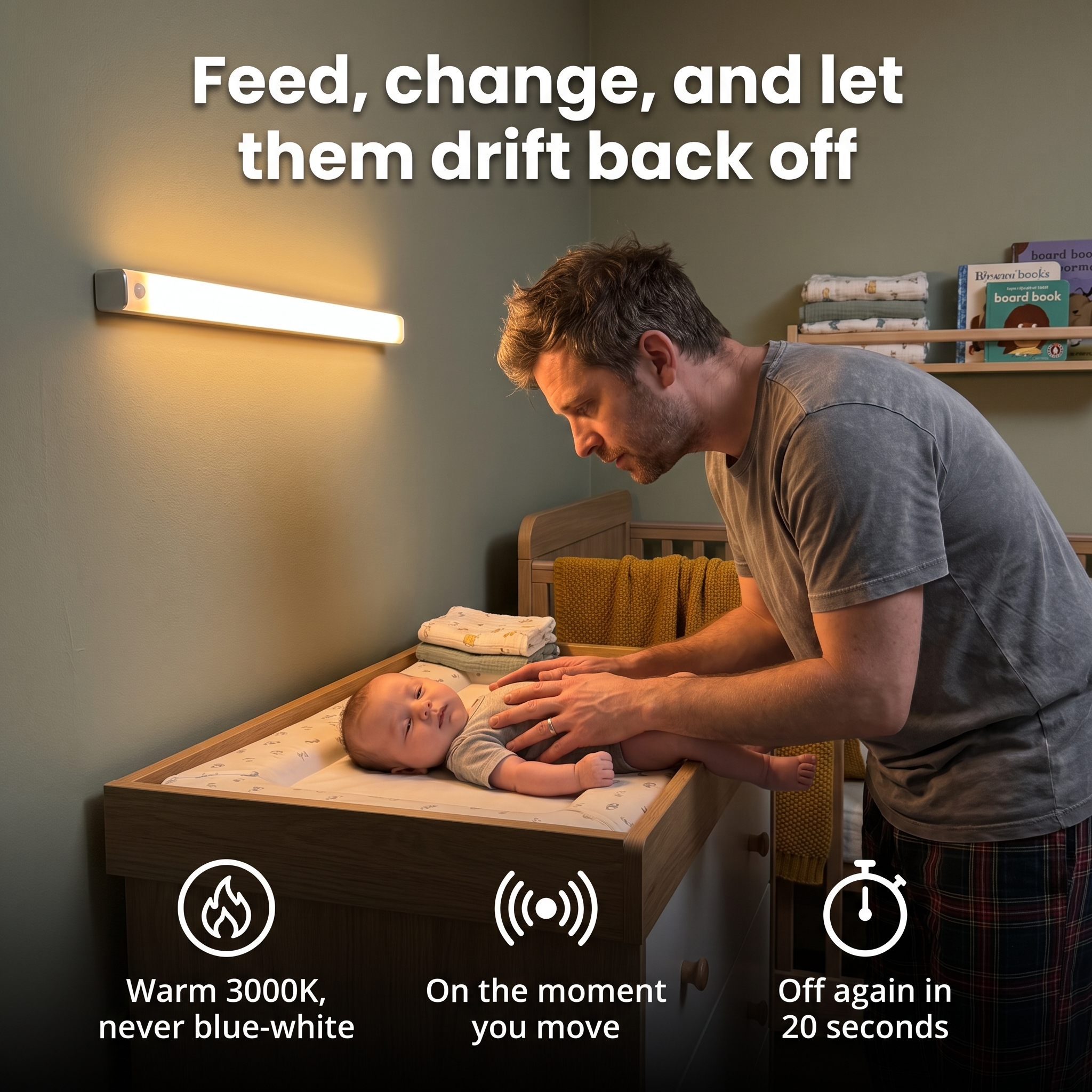
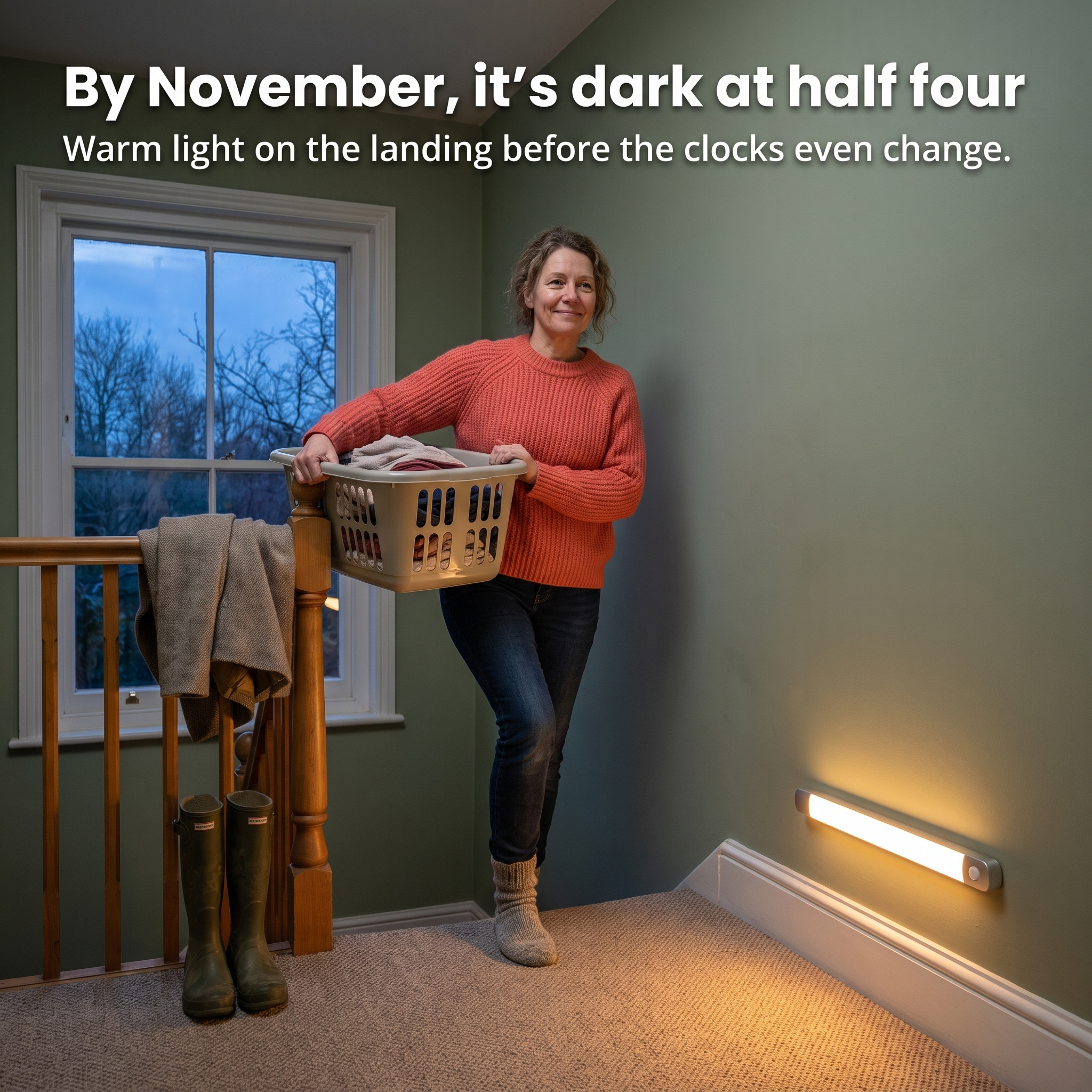
I’m up twice most nights and I used to be wide awake until five. Now the landing lights itself, low and warm, and I’m back asleep in minutes — without waking my husband.
LumaPath™ — The Warm Motion Night Light
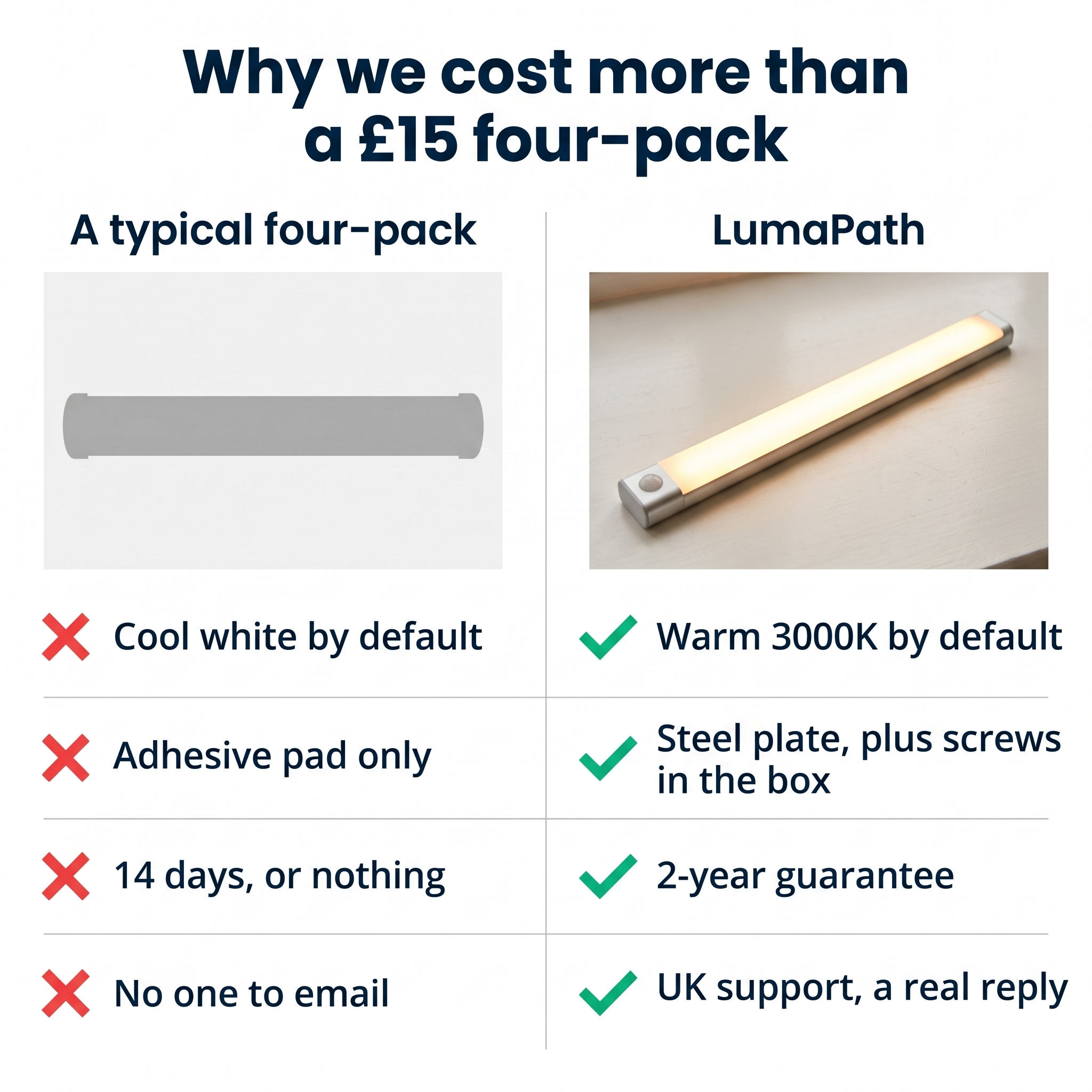
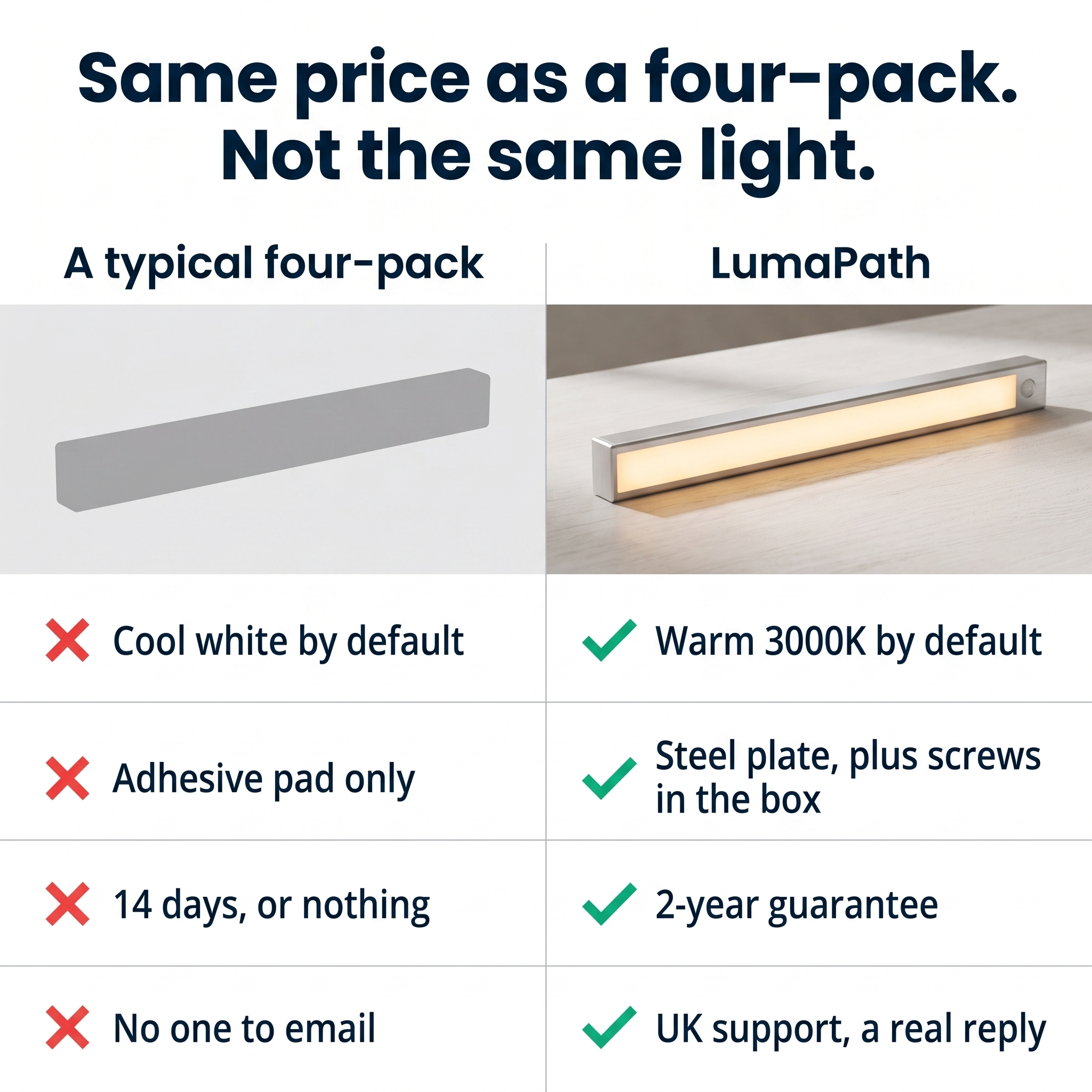
🕯️ Warm 3000K by default — the night setting comes out of the box, not the office white (4000K & 6500K there when you want them)
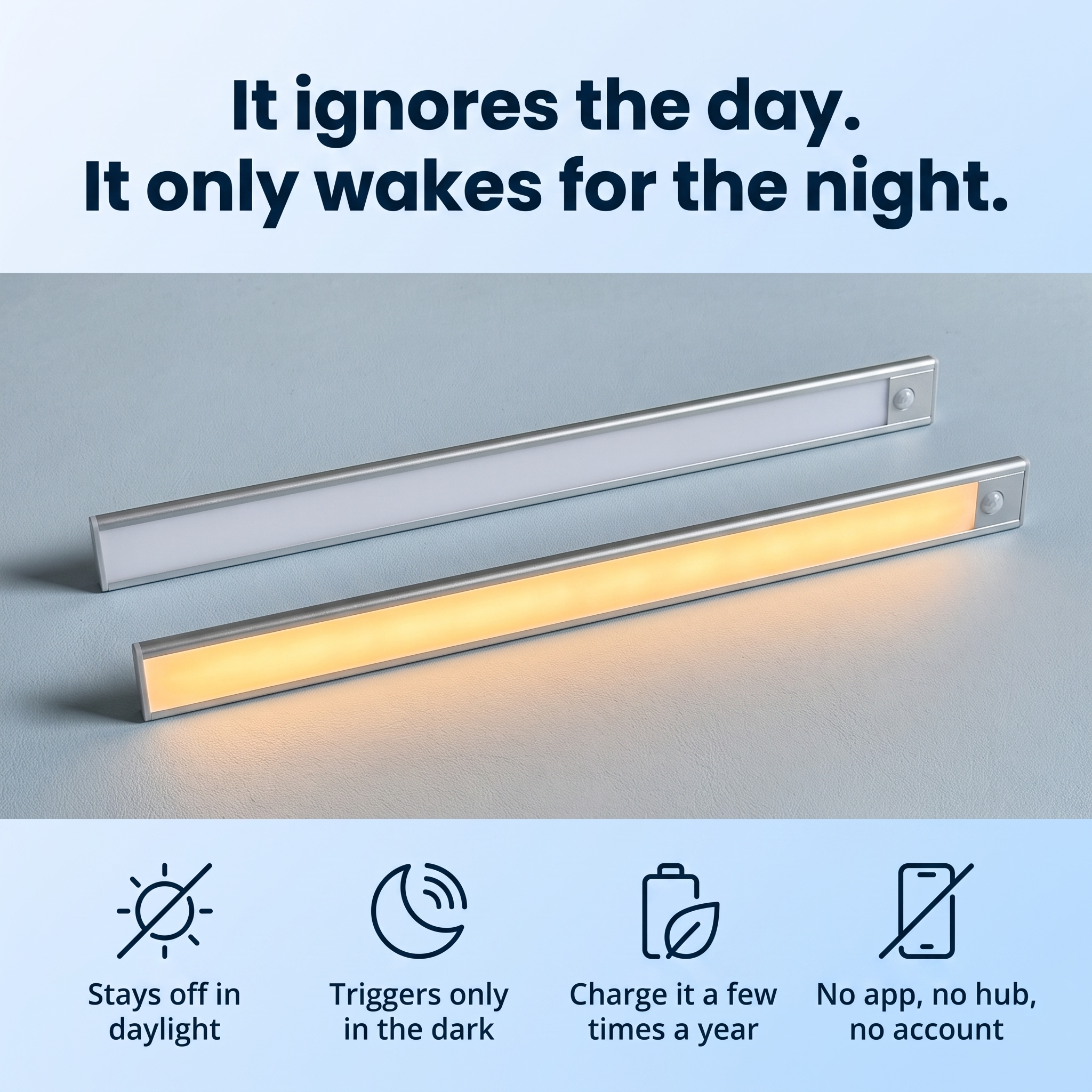
🌑 Night induction: ignores daylight, wakes only in the dark — which is why you charge it about twice a year, not weekly
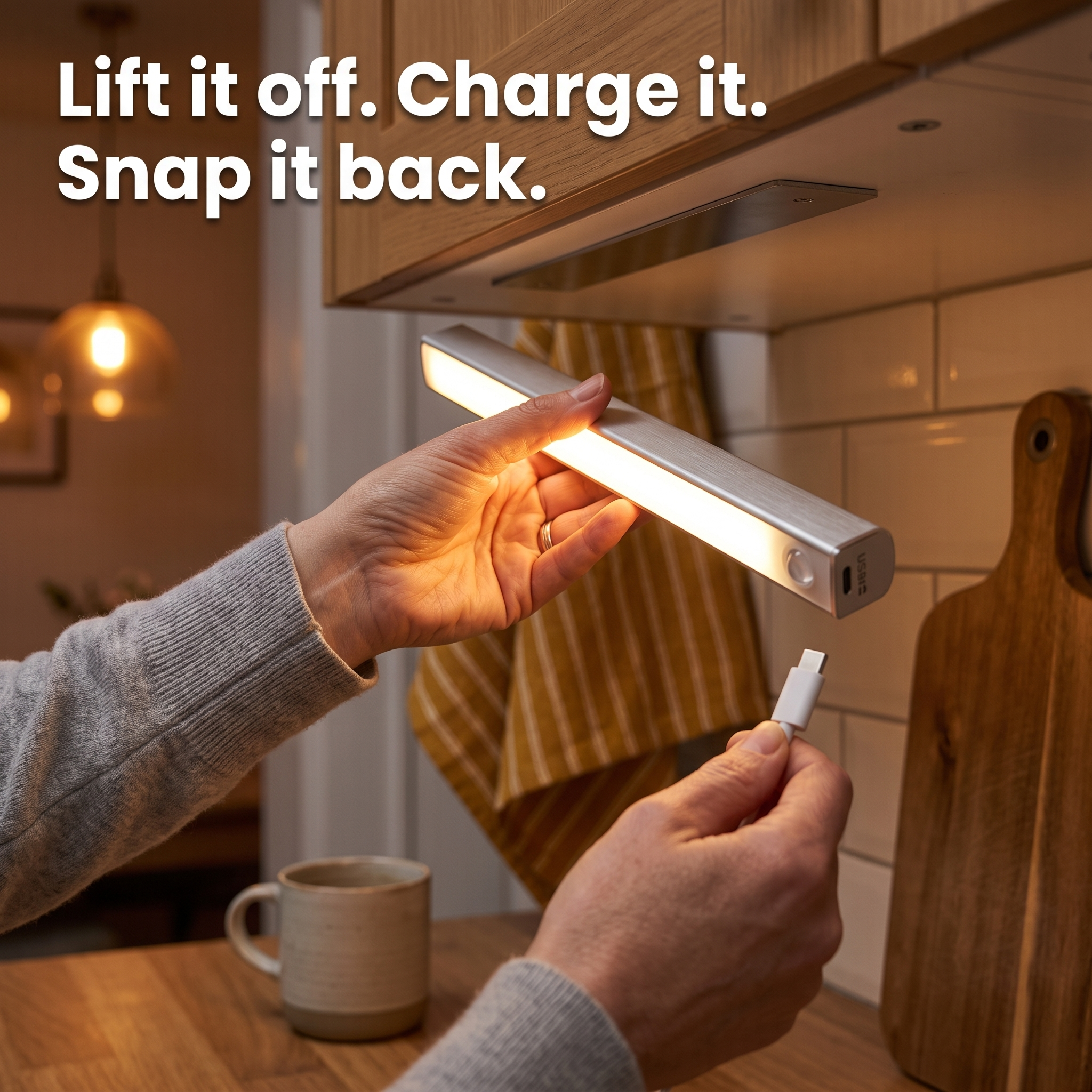
🧲 30 cm magnetic bar — about the length of a ruler — USB-C, no drill, no cable, no electrician, nothing your landlord needs to know about
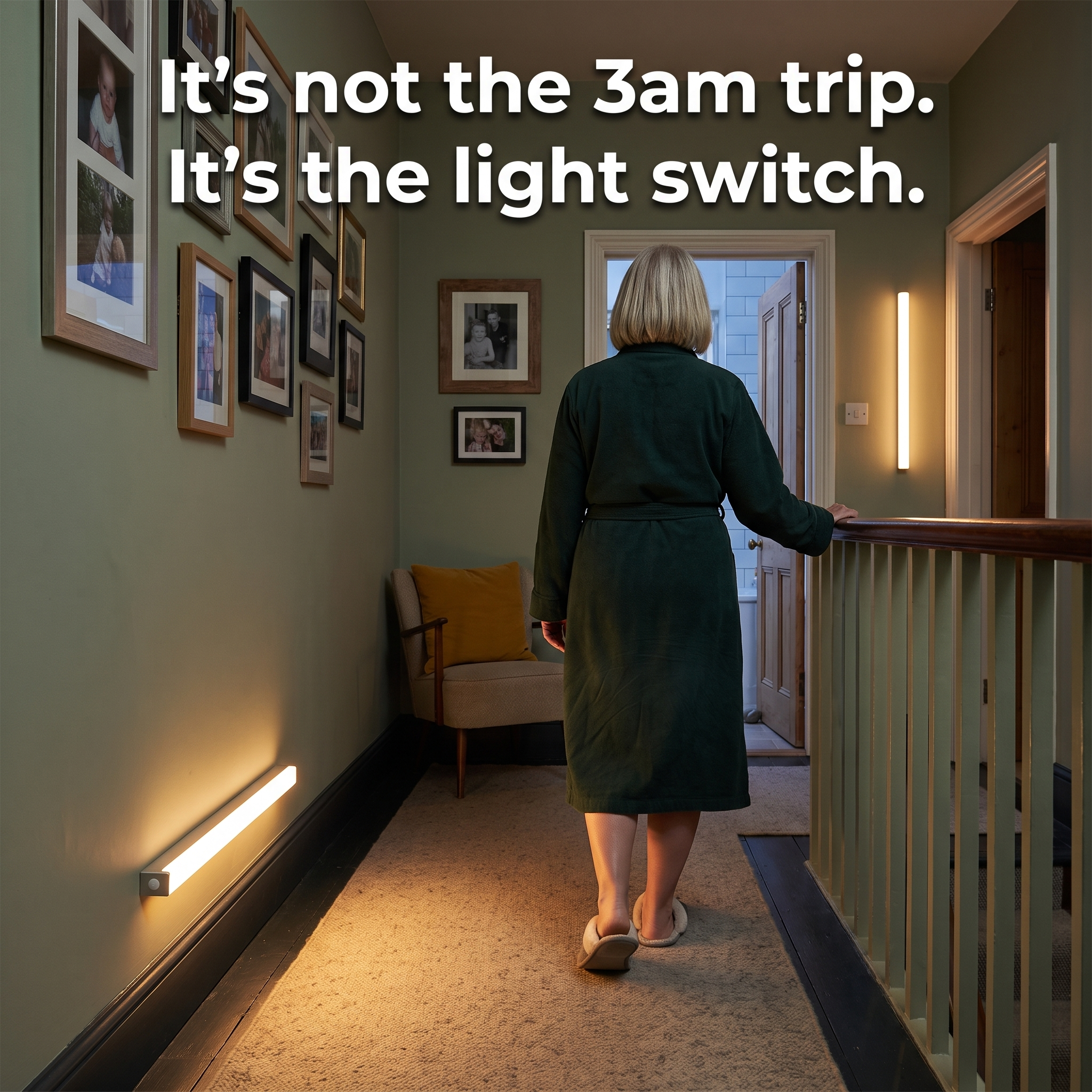
It’s not the 3am trip that ruins your night. It’s the light switch.
Getting up once or twice is ordinary — more than half of us over 50 do it, and no night light is going to change that. The four minutes on your feet aren’t the problem. The forty-five minutes staring at the ceiling afterwards are. And they start the moment your finger finds the switch.
Four minutes, forty-five minutes
The trip itself is over quickly. What follows isn’t. Three nights a week at forty-five minutes each is more than two hours of sleep lost every week — not to your bladder, but to a gesture.
A light built for offices
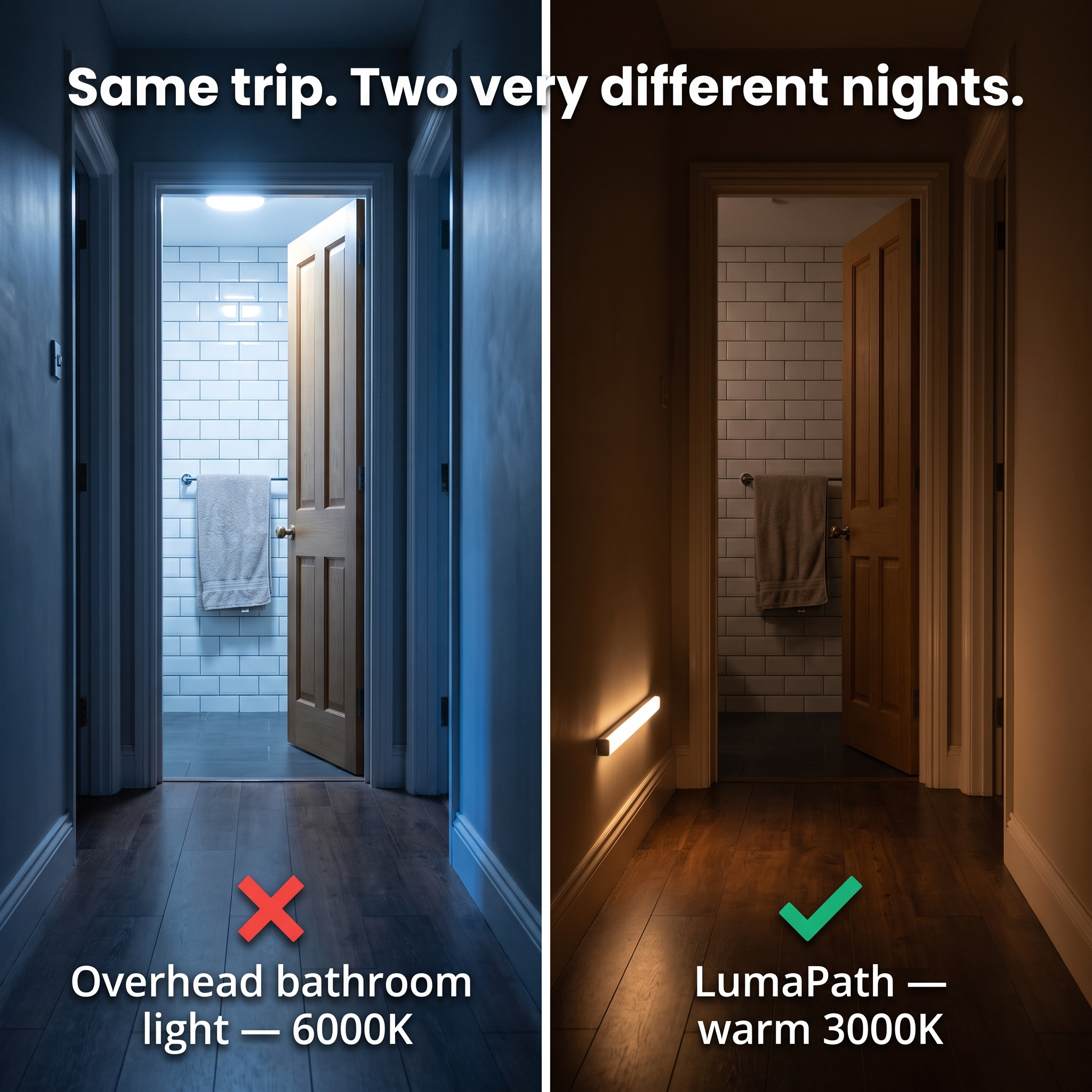
The bulb behind your hallway switch was designed to light a desk: bright, cool-toned, full of blue wavelengths. At 3am your brain doesn’t read it as “hallway”. It reads it as sunrise.
Or you walk it in the dark
So you stop switching lights on, to avoid waking whoever’s asleep next to you — and now you’re feeling for the stairs and catching your toe on the bed frame. Neither option is a good one. That’s the actual problem.
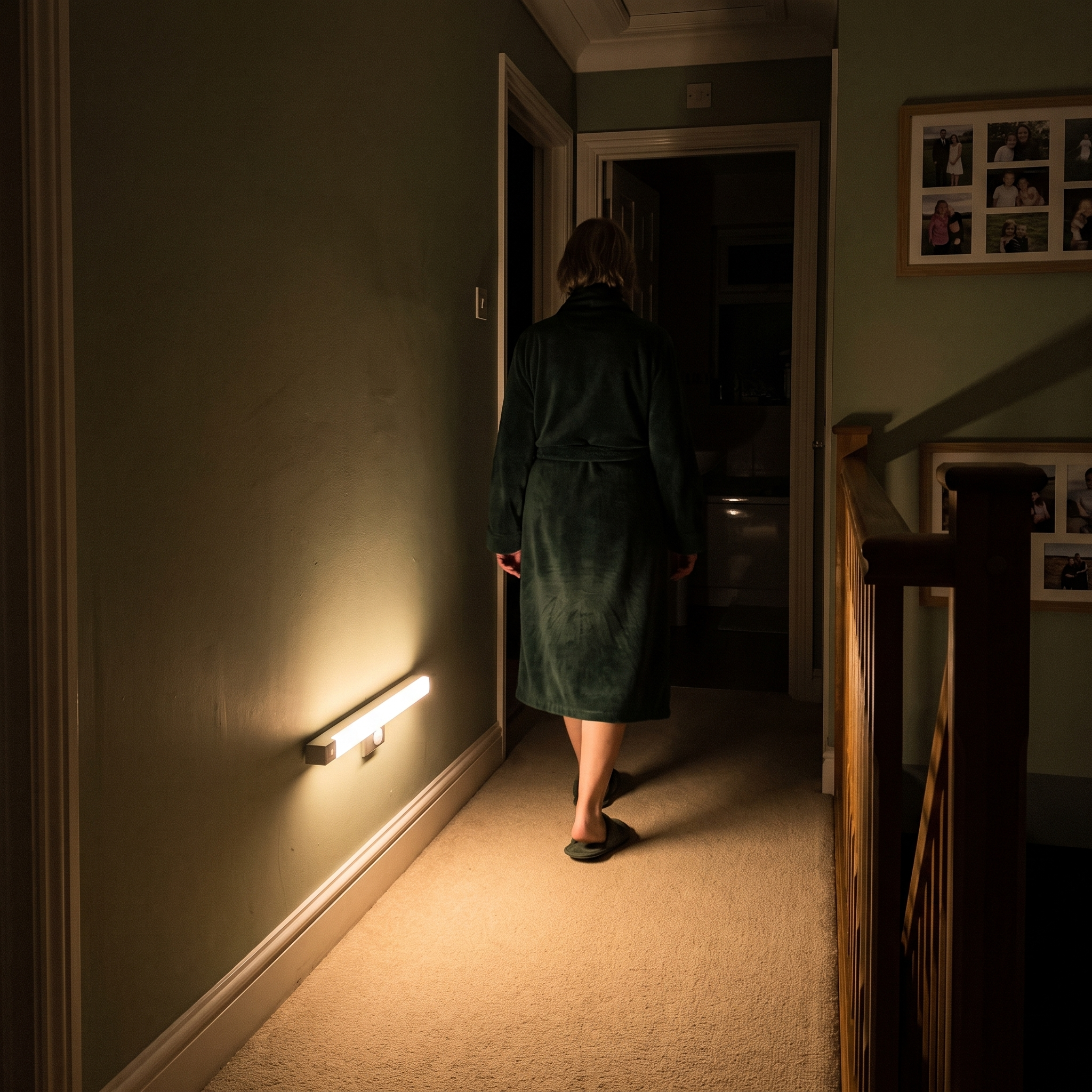
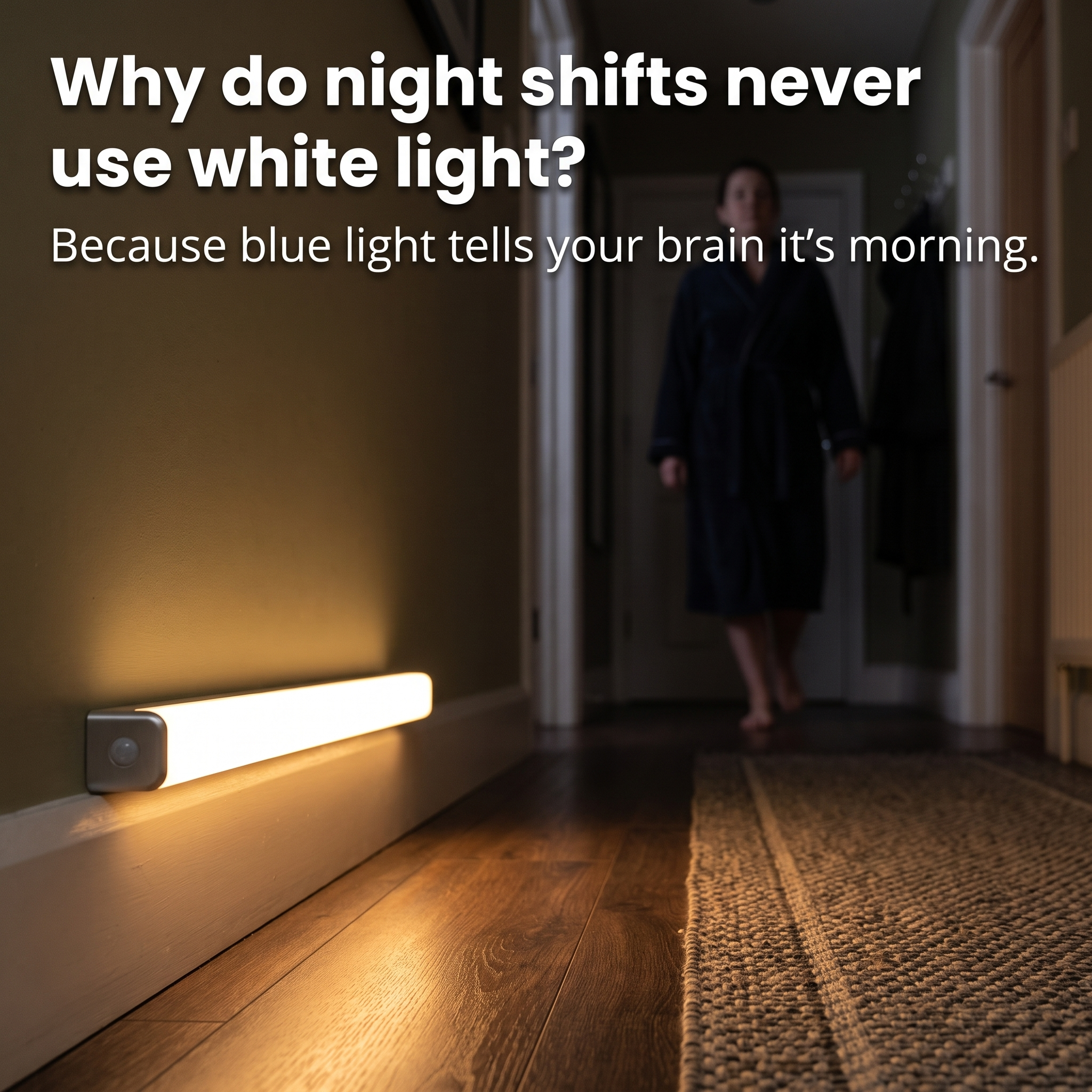
Ships, observatories and night wards never use white light
For over a century, the people whose job is to see in the dark have worked under red and amber light. A watch officer, an astronomer, a control-room operator — none of them reach for a cool white bulb, because it wrecks the eye’s adaptation to darkness and, we now know, tells the body it is morning.
Cool white light (4000–6500K) is rich in blue wavelengths. Blue wavelengths suppress melatonin — the thing that lets you drop back off. A 6000K bathroom ceiling light at 3am is, biologically, hard to tell apart from a sunrise.
This isn’t a laboratory discovery. It’s a hundred-year-old piece of professional knowledge that simply never made it out of those jobs and into our hallways.
LumaPath is that setting, applied to a British landing at three in the morning.
Tuned for the night — not for the office
Every light in this category competes on the same four numbers: lumens, range, LED count, mAh. All of them describe how much light you get. LumaPath is built around the part that actually costs you sleep — what colour that light is, and whether it should be coming on at all.
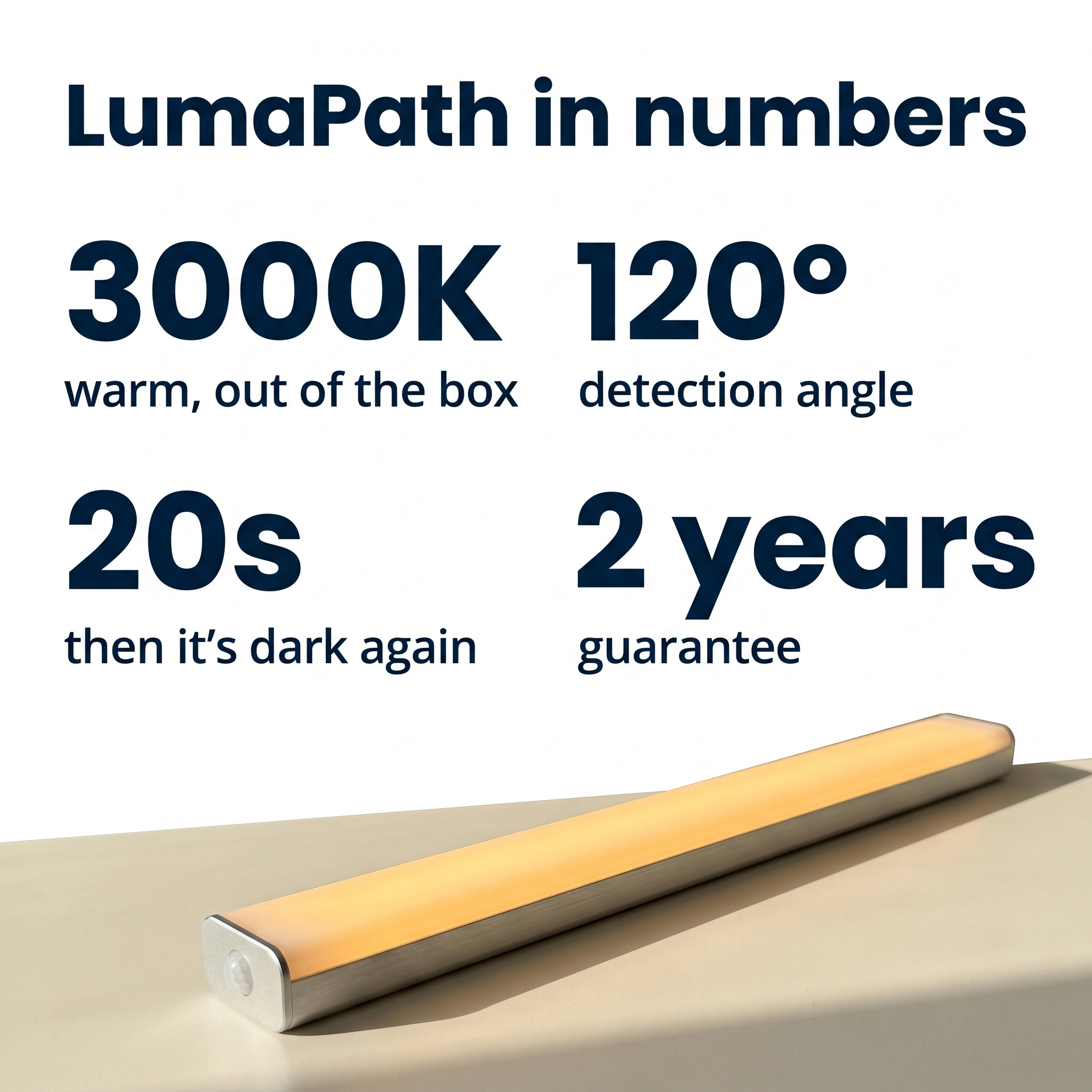
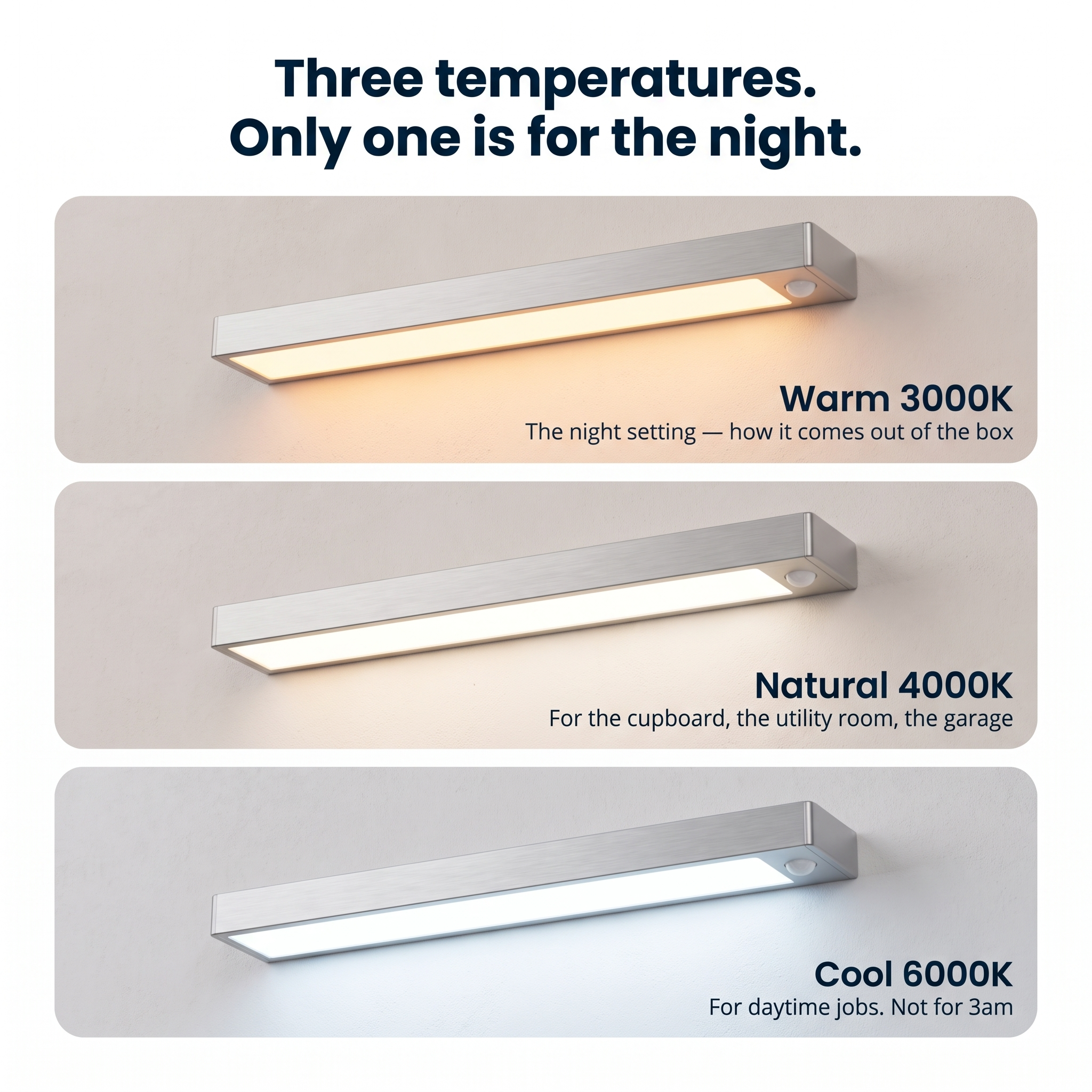
Warm 3000K, by default
It lights up warm, straight out of the box. The 4000K and 6500K settings are there for the cupboard, the garage and daytime jobs — but the night setting is the one you don’t have to go looking for. Everyone else sells bright white as the headline feature. We put it in a drawer.
Night induction: asleep all day
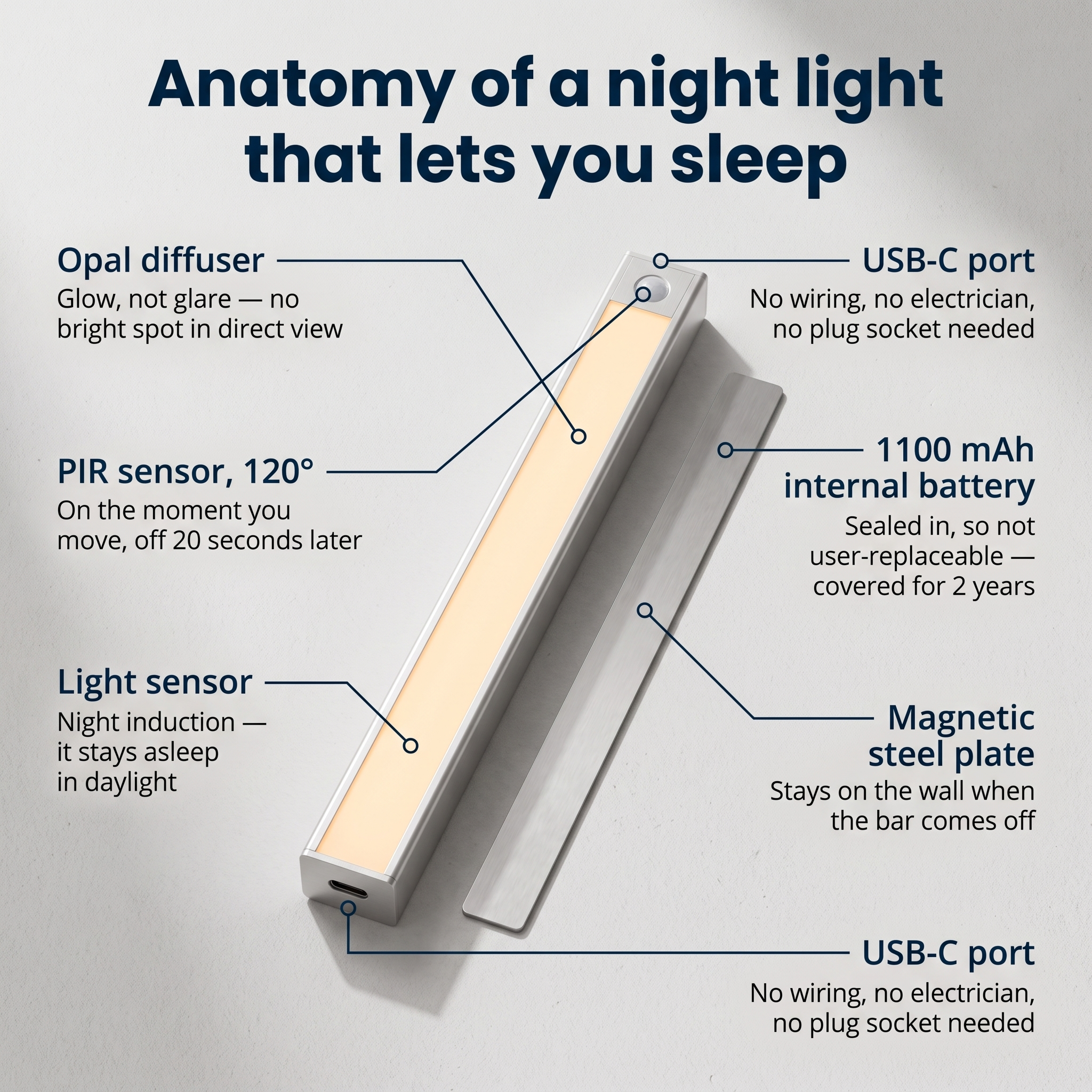
In night induction mode the bar simply ignores you in daylight — it only triggers in the dark, so it isn’t burning charge every time you walk past at four in the afternoon. That one mode is the difference between recharging every week and recharging about twice a year.
Nothing to drill, nothing to install
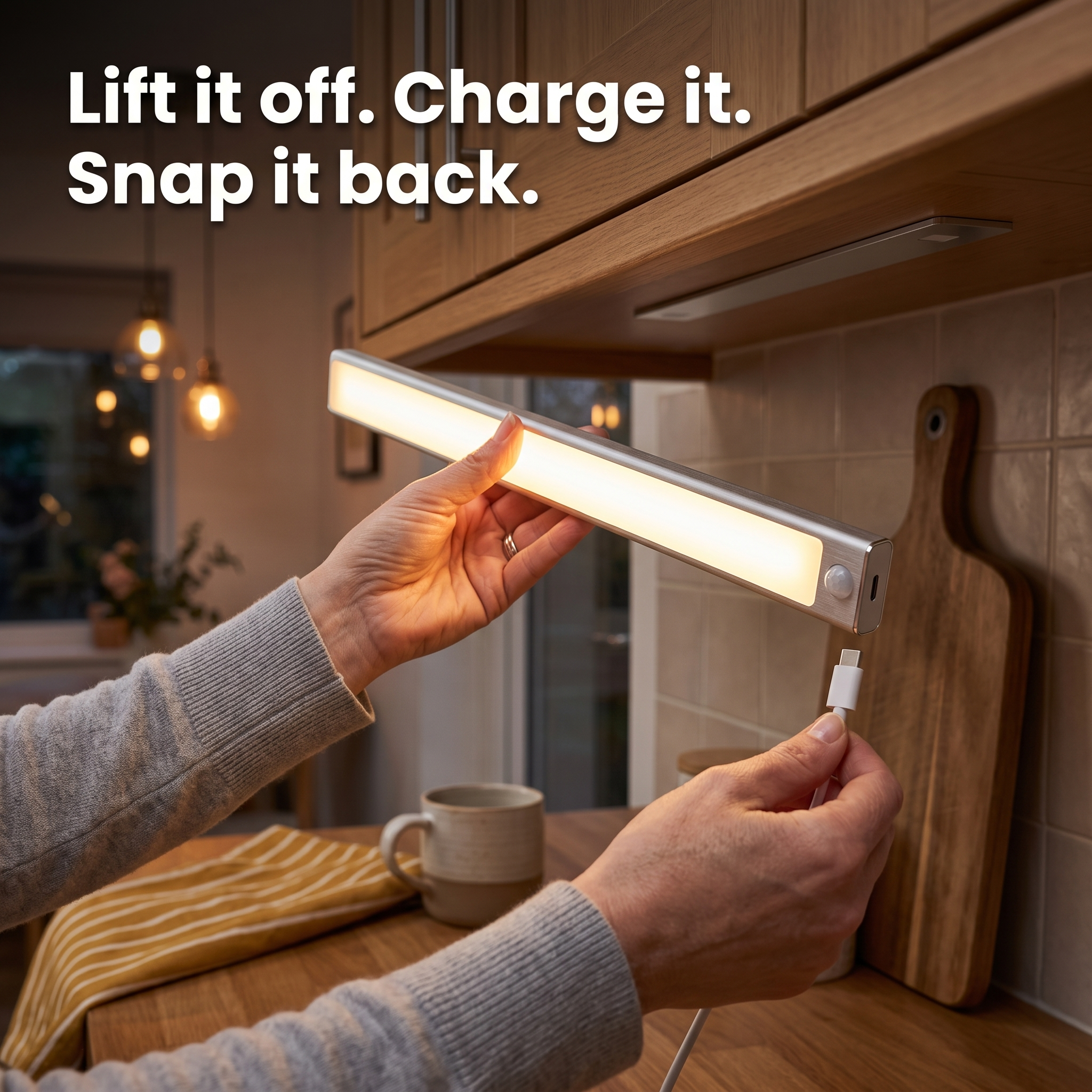
A 4 m / 120° sensor, on the moment you move, off about 20 seconds later. It hangs on an adhesive magnetic plate, lifts off in one movement for a USB-C charge and clicks back without re-aiming. No wiring, no electrician, no app, no hub, no account, no subscription.
It sees you coming. It doesn’t wake you up.


They tried LumaPath™
They loved it
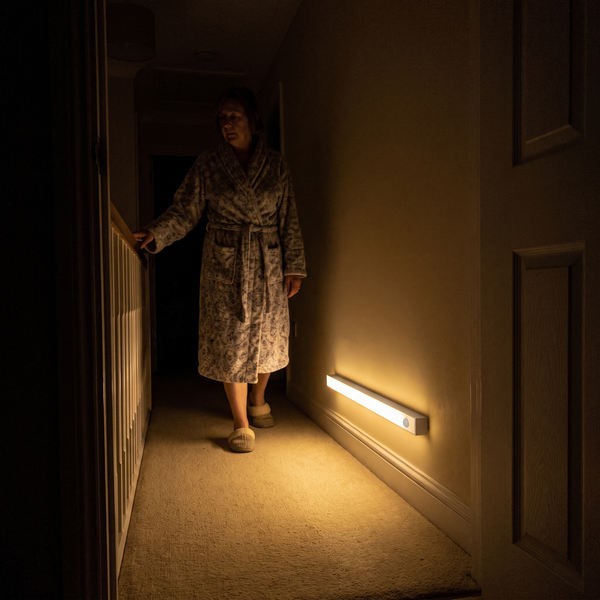
I get up twice most nights. The landing now lights itself, low and amber, and I’m back asleep in minutes instead of lying there until five. My husband hasn’t stirred once.
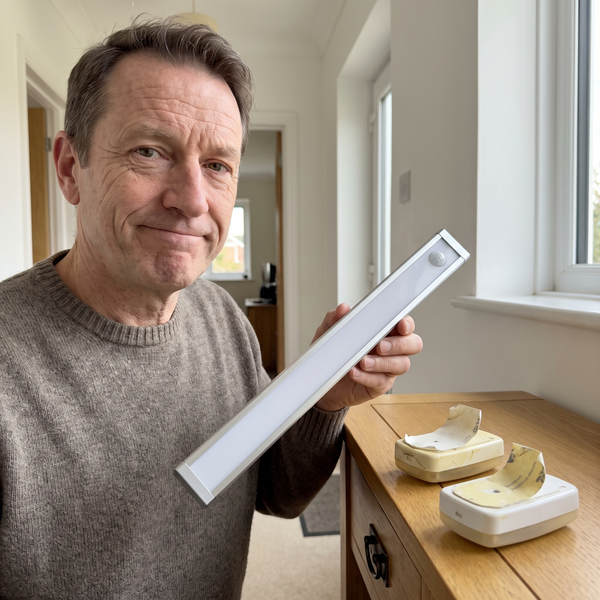
I bought a four-pack off Amazon last year — the adhesive let go by Christmas and the batteries by spring. This one went up in February and is still on its first charge. The night mode is why: it does nothing all day.
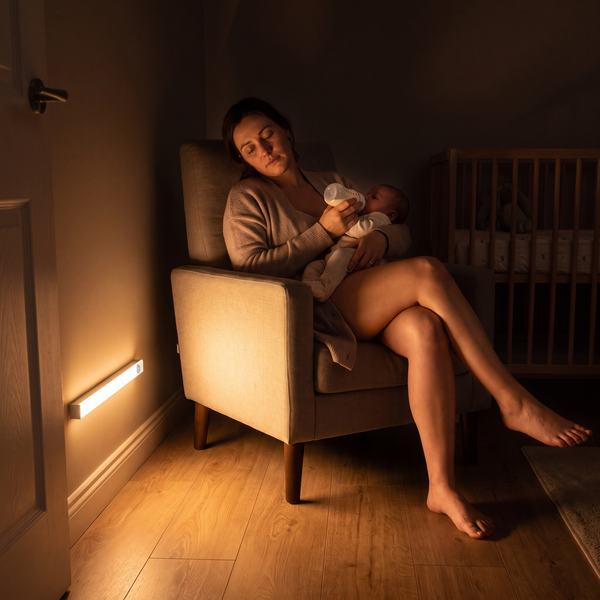
Two of them, bedroom door and top of the stairs. Doing the 2am feed under warm light instead of the big ceiling light has been the single best thing for getting her back down afterwards.
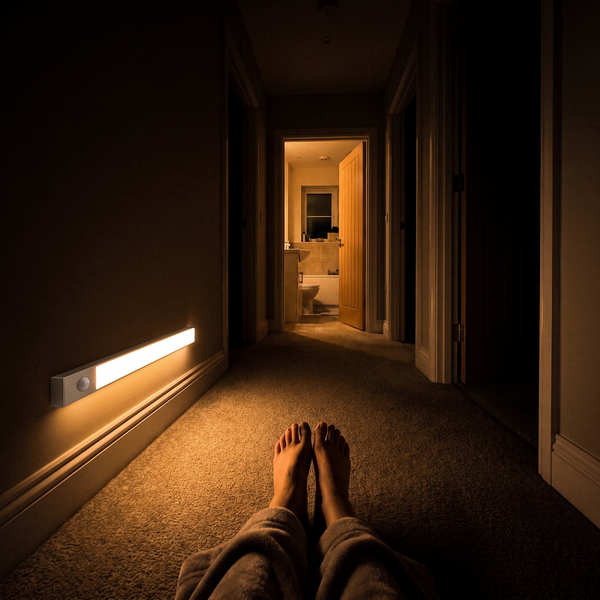
It marks the route, it doesn’t light the room — which is exactly what the page says and exactly what I wanted. If you’re after something to hoover by, this isn’t it.
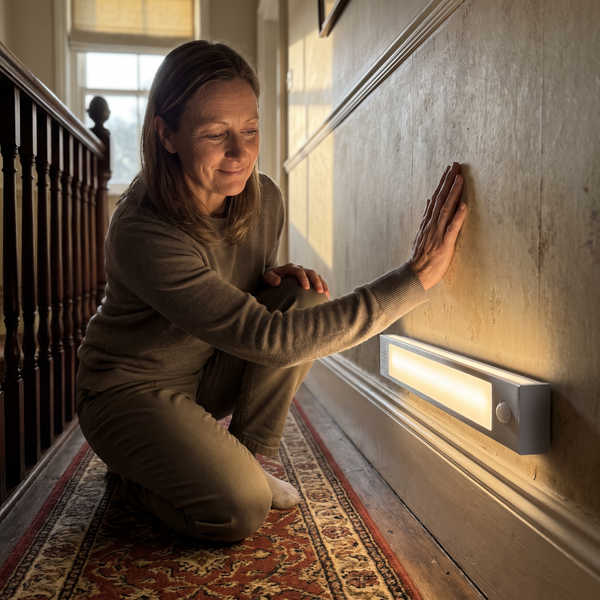
I bought a pair for my mum. No drilling, no plug needed, and it looks like a strip of trim rather than something borrowed from a hospital. She just thinks it’s smart.
One bar rarely fixes it. Map the route instead.
This is the honest reason the 2-pack is our most popular set, and it isn’t a bundle trick: a single bar leaves a gap, and the moment there’s a gap you reach for a switch — which puts you straight back where you started. Most British houses have the same four stops.
Bedroom door
The first three steps — and the ones where you wake whoever’s still asleep. Mount it low, facing the floor, so the light never reaches the bed.
Landing
The turn everyone does from memory. This is the stop most people skip, and the one they come back for a month later.
Stairs
Only if your route includes them. Under the handrail or along the skirting, so the edge of each tread reads clearly on the way down.
Bathroom
The one that matters most — because that ceiling light is the whole thing you’re trying not to switch on.
The smallest set we sell is two bars — which is exactly the classic bedroom-to-bathroom route. We don’t sell them singly, for the reason above: one on its own leaves the gap that sends you back to the switch. Four covers a staircase as well, or a second person walking a different route entirely.
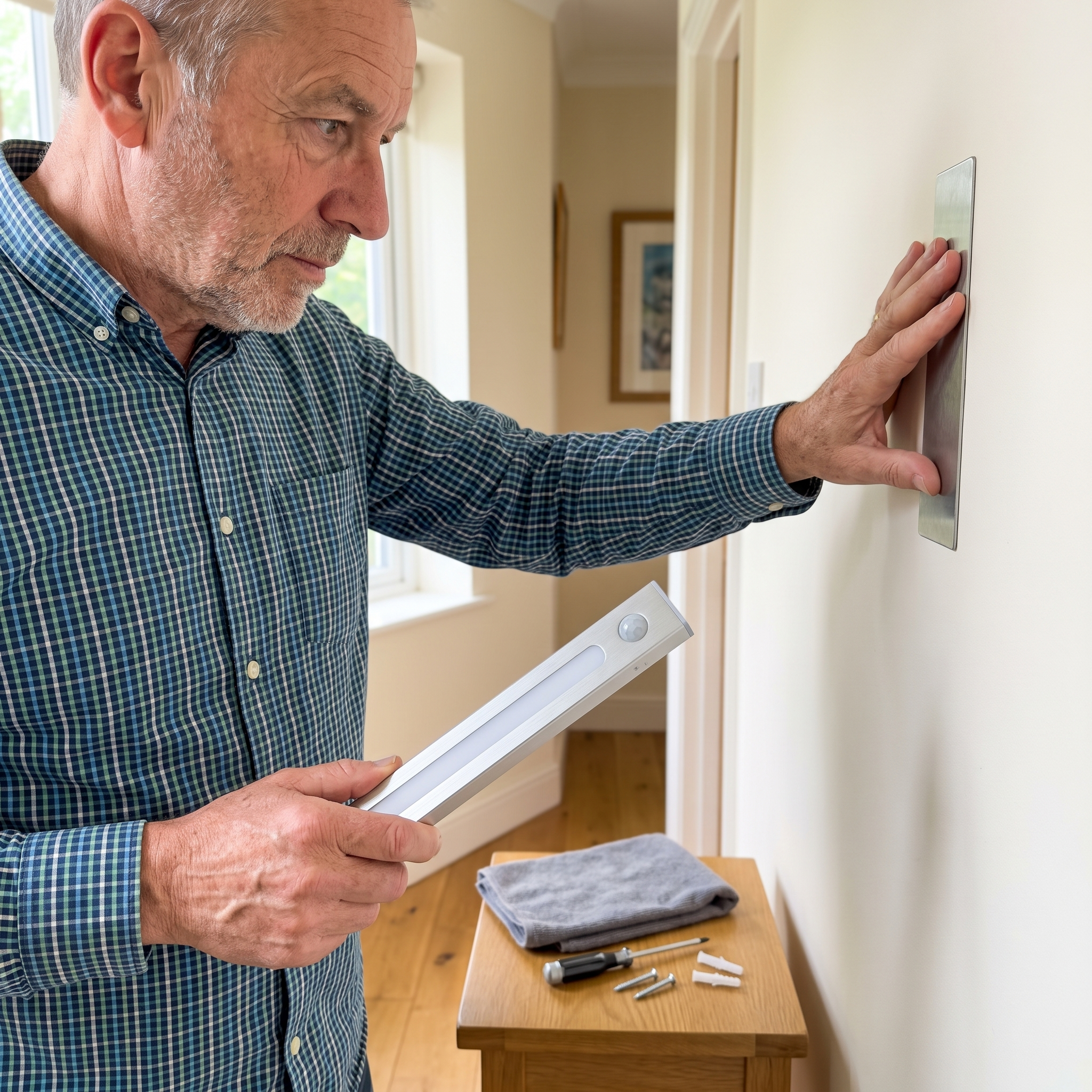
The complaint we hear most: “it fell off the wall”
Read the reviews under any cheap motion light and the same sentence keeps coming up: “the adhesive strip behind the magnetic mount fell off multiple times”. It is the number one failure of this entire category, so it’s worth being blunt about how we handle it.
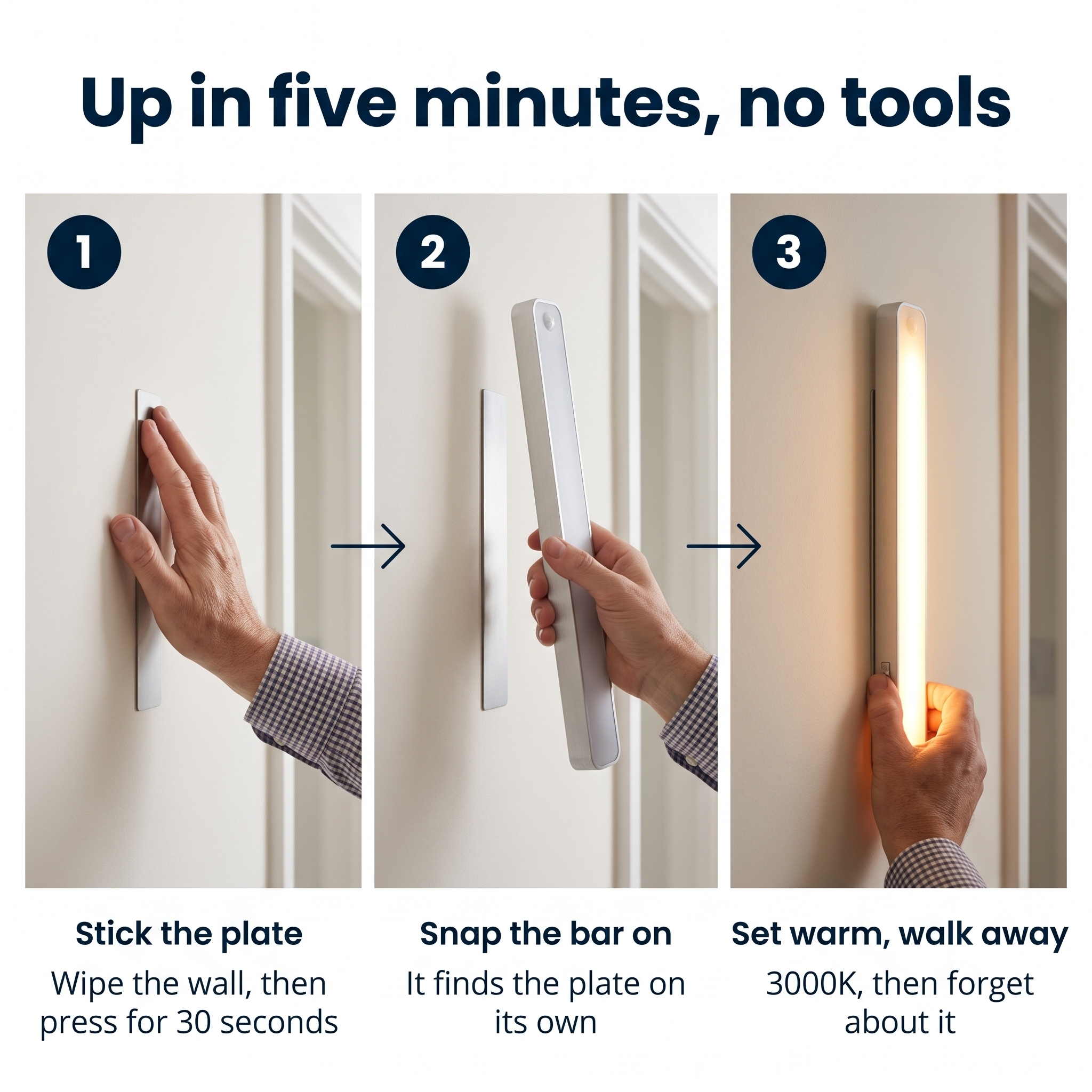
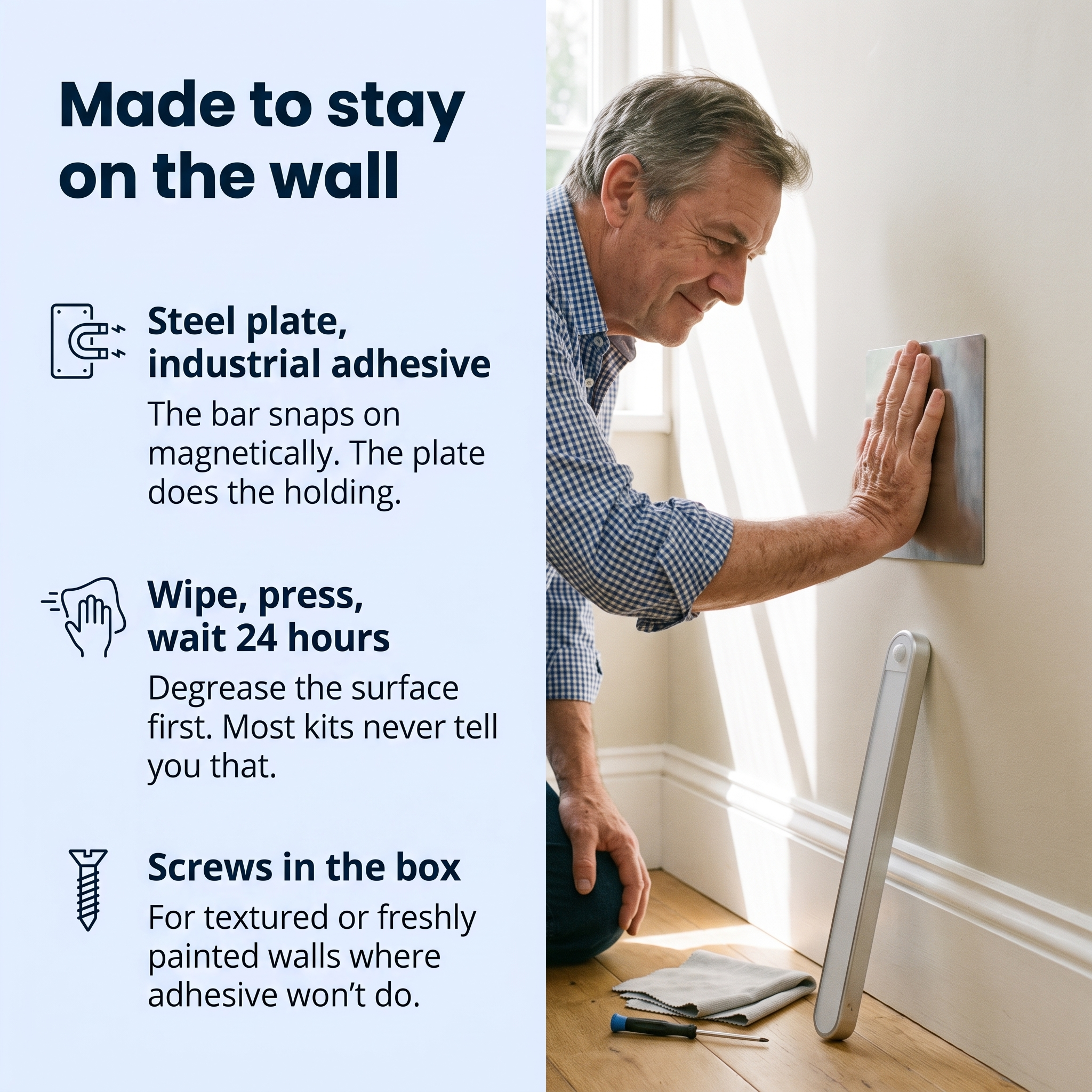
LumaPath hangs on an adhesive magnetic plate. Wipe the wall, let it dry properly, press the plate for thirty seconds and leave it twenty-four hours before hanging the bar — grease and dust kill adhesive mounts far more often than the adhesive itself does. And for textured plaster, painted-over wallpaper or anything else adhesive can’t grip, screws and wall plugs are in the box. We’d rather include them than pretend they’re never needed.
The bar lifts off the magnet in one movement to charge over USB-C, and clicks back on without re-aiming the sensor.
No drill. No cable. No electrician. Nothing your landlord needs to know about.
So why isn’t this dearer than the Amazon four-pack?
It isn’t, and that’s deliberate. Four bars for £39.90 puts us in the same money as a supermarket multi-pack — because we’d rather you lit the whole route properly than bought one good light and kept the switch for the rest of it. What you’re not paying for is the part that makes those packs cheap.
There’s no discount week here and no timer counting down to nothing. The sets are priced so that lighting your whole route costs less than lighting one corner of it, the warranty is two years rather than fourteen days, and if it isn’t for you there’s a 30-day return. That’s the whole offer.
What LumaPath does — and what it honestly doesn’t
The two biggest complaints in this category are the battery and the mounting. We’d rather say them out loud here than let you find them in a review six weeks from now.
✅ What it does
- Lights your route in warm 3000K by default — 4000K and 6500K are there when you want them, each dimmable
- Night induction: ignores daylight, triggers only in the dark — which is what keeps charging down to roughly twice a year
- Detects up to 4 m across 120°, on immediately, off about 20 seconds after you’ve passed
- Mounts magnetically, with screws in the box for surfaces adhesive can’t hold, and lifts off for USB-C charging
- 2-year warranty, 30-day returns, UK-based support — no app, no account, no subscription
❌ What it doesn’t
- The battery is internal and you can’t replace it yourself. A 10 mm bar sealed against bathroom humidity has nowhere to put a battery door. The 2-year warranty covers it, and night induction is what keeps the charge cycles low in the first place
- PIR sensing isn’t laboratory-precise. Detection distance shifts with room temperature, how fast you move, and whether you walk towards it or across it. Pets will set it off sometimes
- It marks a route; it doesn’t light a room. That’s deliberate — but if you want to read or clean by it, you still want your ceiling light
- It is not a medical device and makes no health claim. The NHS suggests turning a light on when you get up at night; we make the light, not the claim
If a night light promises to fix your sleep, that’s a claim nobody can keep. Ours is smaller and testable: you’ll see where you’re going without a cold white light in your face, and you have 30 days to decide whether that changed how the rest of your night went. And one bar on its own rarely does it — there’s almost always one more corner where you’d reach for a switch, which is why the smallest set is two rather than one.
Frequently Asked Questions
Will it wake my partner?
Far less than the switch you’re currently using. Mounted low and facing the floor, the light falls on the carpet rather than into the room, and at 3000K it’s closer to a candle than to a ceiling light — plus each level is dimmable, so you can take it down as low as you can still see by. It also switches itself off about 20 seconds after you’ve passed, so nothing stays lit behind you.
How long does a charge actually last?
Honestly: it depends entirely on how often it triggers, which is why we’d rather talk in trips than in hours. In night induction mode it stays completely inactive all day and lights for roughly 20 seconds per trip, so a household getting up twice a night is looking at months between charges, not weeks — most people charge around twice a year. Leave it out of night induction mode in a busy hallway and you’ll be charging it weekly. That mode is the whole difference.
Will it come on all day, or every time the cat walks past?
Night induction mode is exactly the answer to the first half: below a light threshold it arms, above it the sensor ignores movement entirely. As for the cat — sometimes, yes. A PIR sensor reads changes in heat, and it can’t tell a cat from an ankle. Mounting it low and aiming it along your route rather than out into the room cuts most of it out.
I rent. Can I put this up?
Yes, and it was designed with that in mind. There is no drilling, no cable and no electrician: the magnetic plate sticks to the wall and peels back off without taking the paint with it. Screws are in the box for surfaces adhesive won’t hold — but you never have to use them, and when you move, the whole thing comes with you.
Is it bright enough for the stairs?
It’s bright enough to show you where the treads are, which is the job. It is not bright enough to light a staircase the way a ceiling light does, and we wouldn’t claim otherwise — a bar that lit the stairwell properly would also wake you up properly. Mounted along the skirting or under the handrail, the edge of each step reads clearly. If you want a room lit, use the room light.
What if the adhesive lets go, or the battery dies?
For the adhesive: clean the wall, press for thirty seconds, wait twenty-four hours before hanging the bar — that solves it in the overwhelming majority of cases, and screws are supplied for when it doesn’t. For the battery: it’s internal and not user-replaceable, we say so plainly above, and it’s covered by a 2-year warranty rather than the 14 days you’ll find elsewhere. Email support@novell-home.com and a person in the UK answers.